
Copyrighted materials and personal data in your thesis
Guidelines on what must not be included in the public version of your thesis, information to guide your decisions, and advice on removing material (redactions) or what your next steps might be if redactions aren’t suitable.
The final copy of the thesis you submit for examination can normally contain any information; this is permitted under a copyright exception.
- The use of third-party materials in your thesis must be appropriately referenced (acknowledged) and the use must be 'fair'.
- You do not necessarily need to have obtained specific permission from the copyright holder to reproduce the material for examination purposes.
However, since University of Bristol theses are made publicly available, this means the 'full' copy may include content that must not be published online.
- You must still deposit the examination version in the institutional repository (Pure) as the definitive copy.
- If your thesis contains unpublishable material, you must also deposit a second version: a shareable copy with the unpublishable content removed, known as the ‘redacted’ version. Ensure this version has REDACTED at the beginning of the file name.
The PGR code (18.38 & 15.4-6) requires you to consider what can and cannot be included in the public access version of your thesis when completing your deposit to the Library.
More detailed guidance is available on the Sensitive and Copyrighted Materials: Think Twice webpages. That webpage is intended for all University of Bristol researchers, including PGRs. The guidance and resources on this webpage are specific to these points in the context of preparing your dissertation (thesis).
What must not be published
- People’s personal details (data) such as names, signatures, or addresses; including your student number and your signature on the Author’s Declaration page
- Third-party materials (created by someone else) which you do not have permission to publish or share publicly, eg data which is not openly available, images with copyright restrictions, etc. This might include trademarks, which are a form of intellectual property protection.
- Commercially sensitive information eg relating to a sponsor’s intellectual property or a patent application. Ensure you have formally agreed what you can make public with your research sponsor.
- Previously published content (eg articles) which are not open access. This might apply to a single chapter if you've previously published it as an article or if you are submitting a PhD by publication.
Unless you have been told otherwise as a result of a deferral application, deposit your thesis promptly. Your Thesis Deposit Form will capture what kind of redactions and/or deferral are applicable, and the Library’s eTheses Validation team will ensure your thesis is made publicly available when appropriate.
You are required by law to remove the identifiable personal details of living people (‘Personal Data’) from your thesis before it can be shared publicly.
The relevant Data Protection Legislation is the General Data Protection Regulation (GDPR) and the Data Protection Act 2018. The only exception is when you have a record of a person’s consent to identify them in the public version.
Data you must remove or anonymise can include ‘direct’ (names and addresses) or ‘indirect’ identifiers (information which when combined permits identification). See our guidance on Personal data & scholarly publications for more information.
Anonymisation
Effective anonymisation approaches may be appropriate in your research practice and mean data is anonymised even in the examination copy of your thesis.
- You must carefully consider how you will handle Personal Data at an early stage in your research process.
- Consider what approach to use and how to do this ethically using the Information Commissioner Office’s Guidance on Anonymisation.
- You should talk to your supervisor about the approaches you plan to take.
- If you choose to include identifiable data in your examination copy, you must create a modified version for public access at the time of deposit.
- This may mean redacting certain sections which present the identifiable data. Guidance on redactions is further below on this webpage.
- If the identifiable data represents a significant portion of your thesis or is widespread and minor redactions would not be reasonable, consider requesting approval for substantial redactions via the deferral process.
For more information on sensitive data and best practice, see the Sensitive data bootcamp.
Photographs of people
If your thesis contains images of people who are recognisable, you will normally need written permission (consent) from the people in the photographs before you can publish them.
- Consult the University’s Research Ethics webpages for guidance and templates.
- Photographs of people going about their everyday business in a public place (where they could reasonably expect to be photographed) may not always require their permission to be reproduced, e.g. shoppers walking in a high street.
- Blurring features to reduce the risk of re-identification may be appropriate, but this does not always replace the need for consent.
The Data Protection Legislation only applies to information about living people. While it is not illegal to share data which identifies deceased persons, there may be other reasons for not doing so; for example, spiritual, cultural, or political sensitivities.
If you wish to include materials that someone else has created, you need to have the permission to do so. The rights of a creator to restrict the reproduction of their work is governed by the Copyright, Designs and Patents Act 1988 (the CDPA).
- You should identify who holds the copyright on the materials you wish to reproduce in your thesis.
- Once you have decided to include third party material, don’t wait to contact the rights holders – obtaining permission can take months if there is a delay in the rights holder responding to you.
- Permission may not be required to reuse material (eg public domain works, open access content) but in the absence of a clear copyright status or permissions, you should assume copyright applies and permission is required.
- Keep track of the copyright information and permissions for any third-party materials you identify. Use a tool like our Thesis Copyright Clearance Appendix (Office document, 153kB); when it comes time to deposit your thesis with the Library, you’ll easily know what redactions may be necessary in the public version of your thesis.
You can find out more about ‘clearing’ copyright permissions on our page about Third-party copyrighted materials.
Requesting permission to reuse materials
Rights holders may grant you permission (a licence) to reuse their copyrighted material at no cost or request a fee. Rights holders may waive a fee if they know you are reproducing material for the non-commercial, educational purpose of submitting and publicly sharing your thesis.
In your request for permission, let the copyright holder know your thesis will be shared open access (under a CC BY-NC-ND licence) but that the repository’s terms of use clearly state third-party rights holders retain their copyright.
- Ask them how they would like their copyright to be presented in a credit line (e.g. © [Year, Name. All rights reserved. Reproduced by permission.]
- Including a credit line for each image or figure communicates that you have permission to include in the public access version of your thesis.
- For more on copyright and more examples of credit lines see Third-party copyrighted materials.
If you do not receive permission to include third-party copyrighted materials in the public access version of your thesis, you can still include this in the examination copy (there is an exception under the CDPA to permit this) but you must remove or redact those materials in the version which will be shared publicly.
Other intellectual property (eg Trademarks) may also require attention when you prepare the public access version of your thesis. See the detailed Trademarks guidance.
If you have previously published material which will be included in your thesis, you may need permission to reproduce it in the public access version of your thesis. Whether you have previously published a single chapter or are pursuing a PhD by publication, you should review the detailed Previously Published Content guidance and consider whether you have the appropriate permissions (or workarounds) at an article-level.
- PhD by publication: formally known as "Doctoral degree by published work" at the University of Bristol. Normally means that several previously published outputs will be combined in the submission.
- Single chapter: you may have published one (or more) articles prior to submitting your thesis, and are reproducing this article as a chapter in your submission.
Redactions (removing material which must not be published) do not need to be applied to your examination copy. The best time to apply redactions is after your thesis has been submitted for academic assessment and before you deposit it to Pure.
You should ensure that whatever you remove does not change the pagination in the redacted (public access) version of your thesis.
Remember, the unredacted version must still be deposited, but it will not be made publicly available.
Redacting short sections of text
Remove the specific text and replace it with ‘[Redacted]’ (include the square brackets). You may wish to give further information, such as the reason for the redaction eg ‘[Redacted to anonymise]’.
It may not be necessary to redact short sections which are being reproduced for quotation or criticism purposes - in these cases, be sure you've followed appropriate academic practice in citing the original works.
Redacting longer text, images or figures
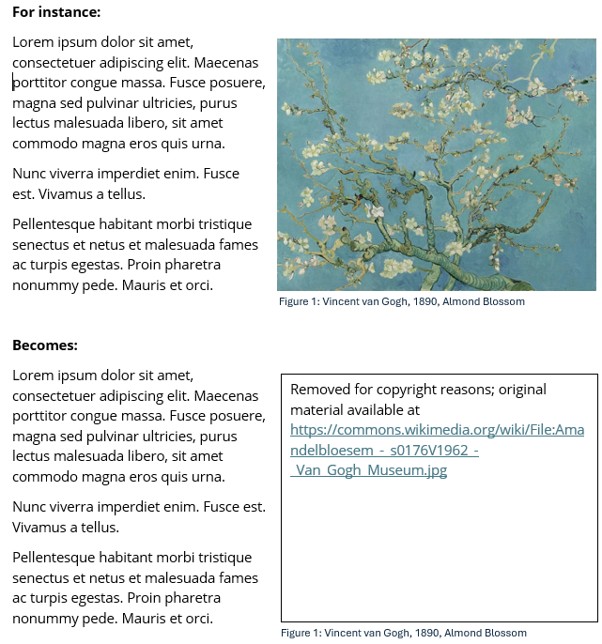
Redacting longer sections of text, images, or figures may impact the page numbering of your thesis. We recommend removing the material and replacing it with a text box of the same size. Include [Removed for [‘x’ reason, e.g. copyright]. This is sometimes called ‘tombstoning.’
If the material is available on another website, such as an archive, an alternative way to redact material you cannot reproduce directly is to provide a link to the alternative source. When you remove the text, images, or figures, include, for example, [Removed for copyright reasons; original material available at (link)] in the text box instead. This will help your readers consult the material you referenced, even if you can’t include it in the public access version of your thesis.
If your thesis contains information which must not be published immediately, but could be published in the future, you can request access to that material be deferred so that a redacted version will be available for a period and the full version will be released later. For example, if your thesis contains information which will be included in a patent application, that information should not be made public before the application is filed but it can be made available after a delay.
A ‘deferral’ is a delay to public access and normally requires University approval through the deferral process.
In exceptional circumstances, it may never be suitable to make parts of your thesis publicly available; for example, where material has national security implications. Requests will be considered on a case-by-case basis through the deferral process.
To request approval for substantial redactions or a longer deferral, review the guidance on Delaying public access to your dissertation (thesis).
Minor redactions are made at your discretion. This involves the removal of small amounts of personal data and third-party copyrighted materials.
Major redactions require formal approval through the deferral process. The personal data and/or third-party materials may be so substantial or are too widely dispersed that significant portions of your thesis need to be amended.
A deferral of longer than 12 months requires formal approval through the deferral process. A longer embargo or a closed deposit may be necessary, eg to protect commercially sensitive material.
Further information on deferrals and redactions is available on the Delay public access to your dissertation (thesis) webpage. Remember to submit any application for a longer deferral or substantial redactions in good time to ensure a decision can be made before your deposit deadline.
Generally, your workflow to ‘clear copyright’ (obtain permissions) might look like this:
- Identify any third-party material you want to include
- Check whether you need to obtain permission to reproduce the material
- Identify the copyright holder
- Request permission and wait for a response
- Track (record and retain) permissions information
- Acknowledge (credit) the copyright holder and creator
- Redact material which cannot be published
Review the detailed guidance in Copyright Clearance Workflow (Theses) (PDF, 194kB) before beginning to prepare your thesis.
Previously Published Content
If you are submitting a 'PhD by Publication', you must include the published work(s) as part of your submission for examination. If you are submitting a traditional PhD dissertation but have previously published one or more articles which are chapters in your thesis, the same guidelines below will apply for the individual article(s).
Whether you published an article open access and the conditions of your author agreement may dictate how you can include those works in the public access version of your thesis which will be available in the Bristol Research Portal.
Published open access
If the version of the article on the journal’s webpage (Version of Record or 'Publisher's version'; version which has been formatted and copy edited in the publisher’s style) is published open access, ie under a Creative Commons or equivalent licence such as a Crown Copyright licence, you can reproduce that copy in the public access version of your thesis.
Published non-open access
When publishing an article non-open access ('subscription route'), you will normally sign an author agreement with the publisher which requires you to transfer or exclusively licence the copyright in the article to the publisher. The agreement will include specific rights or permissions granted back to you about how you can reuse your article.
The agreement may already include permission to reproduce the Version of Record in the examination copy of your thesis. Check the journal or publisher's policy to be sure - and ask for permission if it isn't clear. Since there is a limited audience for this version and it is a degree requirement, publishers will normally agree to this if it isn't already in their author agreement or policy.
But the agreement may not include permission to reproduce the Version of Record in the public access version of your thesis. As with any other third-party materials, you need to have permission to reproduce an article originally published elsewhere; so, if your publication(s) is not open access, consider one of the options below when preparing the public access version of your thesis.
You may obtain permission to reproduce the Version of Record in the public version of your thesis by:
- checking your author agreement, or the journal/publisher's policy to see if they have already granted you this permission.
- Be sure that the permission includes the public version of your thesis, not just the examination copy.
- Include any necessary statements, eg 'Reproduced by permission' when you include the Version of Record in your thesis.
- requesting specific permission from the publisher.
- You can let them know your thesis will be available under a CC BY-NC-ND licence but that the Version of Record will be reproduced with its own separate copyright statement. The Bristol Research Portal confirms that some rights in third-party materials may be reserved in theses.
If the publisher only permits you to include the publisher's version in the examination copy and/or requires a fee for permission to include it in the public version of your thesis, you should consider options 2 or 3 below instead when preparing your thesis files for deposit via Pure.
Even if the Version of Record is not open access, the accepted manuscript may have been made available in an institutional repository or pre-print server under a Creative Commons licence.
- In this case, replace the published version with the open access accepted manuscript version in your public thesis file. Include the DOI to the published version and a short explanatory note at the top: eg ‘The Version of Record is available at [DOI]; the Accepted Manuscript is reproduced below, available open access at [Link to AM record in a repository]’.
- To ensure you can use this approach as needed, we recommend always including our Scholarly Works Policy statement in your submitted manuscripts and creating an output record with the Accepted Manuscript in our institutional repository (Pure) on acceptance.
If the Version of Record is not open access and there is no other OA version of the article (like the accepted manuscript) either.
- You will need to redact in full that section of the public access version of your thesis and include a statement like ‘This article is available at [DOI] but has been redacted in this public version of the thesis due to copyright restrictions.’
- Some accepted manuscripts may be made available after an embargo period in an institutional repository but if they do not include an open licence (eg CC BY), you may not have the right to reproduce them.
More on Personal Data
For more information on sensitive data and best practice, see the Sensitive data bootcamp and review our Personal Data & Scholarly publications guidance.
Remember that a photograph of a person constitutes their Personal Data. See the section on Assessing personal data for when you do and don’t need to seek their permission to use their photograph.
More on Copyright
Top tips:
- Request permission as early as you can because gaining permission takes time.
- Use our Thesis Copyright Clearance Appendix (Office document, 153kB) to help you track copyright information and identify when you may need to redact materials in your publicly available thesis.
If you wish to publish from your thesis in the future, you will need to secure permissions from rights holders for each new reuse. The good news is you’ll know who they are and how to do it after clearing them for use in your thesis!
For more general information on copyright, read our Third-party copyrighted materials and Copyright for Researchers guidance. Please contact lib-copyright@bristol.ac.uk with any copyright questions.
It is ultimately the responsibility of the person disseminating the information to ensure that it complies with any applicable legislation (eg data protection, copyright). The information provided by the Library is intended as general guidance on relevant issues in disseminating research and does not constitute legal advice. Complex queries may be referred to other teams within the University to formally advise on legal and compliance matters.