
Conference networking led to internship project and graduate job with Cohere
PhD student Sam Bowyer- a member of the EPSRC Centre for Doctoral Training in Computational Statistics and Data Science (COMPASS) - presented his research findings in Vancouver, and returned to Bristol with a valuable industrial contact.
Sam’s COMPASS PhD work was spotted by Canadian multinational technology company, Cohere, at the International Conference on Machine Learning (ICML) in Vancouver in Summer 2025. Presenting his research on rigorous statistical evaluations of large language models (LLMs), Sam got talking with Kris, a member of Technical Staff at Cohere.
Founded in 2019, Cohere specialises in large language models (LLMs) and AI products for regulated industries, in particular finance, healthcare, manufacturing, and energy, as well as the public sector. They are considered an alternative to US companies, such as OpenAI. Headquartered in Toronto, Cohere also has offices in London, New York, and Paris. In Autumn 2025, when Sam was seeking internship opportunities, Cohere was an obvious industrial partner to approach as he knew his work was relevant to them.
Joining Cohere as an intern
Sam took up a 16-week paid internship in January 2026, spending 1-3 days a week working from their London office, and the rest of the week working from home. The environment was very stimulating, with half a dozen other interns based in the same location, all from different universities. Sam participated in their weekly reading group, where he gained more experience in talking about his work, especially in adapting the level of detail to suit different audiences.
‘In my first week, my boss encouraged me to contact as many colleagues as I could to set up 30-minute chats. Not only was this very beneficial for my work for the next four months, but it was also a really useful soft skill to practise! Working in the London office, I really enjoyed being surrounded by people who were working towards the same goal, as well as having in-depth chats about ideas and other projects’. Sam Bowyer, COMPASS PhD Student.
Using statistics to speed up computations
Sam found working in a commercial environment to be quite a learning curve, however there were definite mutual benefits. Coding in Python, Sam worked on developing efficient benchmarking techniques, aiming to lower the computational cost of evaluating LLMs by predicting full benchmark scores using only a subset of a benchmark’s questions. He managed to shrink the size of the test set, meaning the computations could be carried out in 10% of the time. Sam had previous experience of using the super computer facilities in Bristol during his PhD, although he found Cohere’s huge computing infrastructure enabled the running of a much larger variety of experiments.
Gaining research independence, and a full-time job
Initially, Sam had thought his internship would be a standalone project, however it worked out even better than expected. He gained research independence, writing a paper with Cohere colleagues – without his PhD supervisor – on using statistics to evaluate LLMs more efficiently. Sam returned to the University of Bristol in May 2026 to write up his thesis. Cohere were so pleased with Sam’s work that they offered him a job as a member of Technical Staff starting in September 2026.
‘I really enjoyed my work at Cohere, and contributing towards improving LLM evaluation by looking to classical statistics. Huge thanks to Kris, Acyr, and everyone else at Cohere for a great internship. I can't wait to re-join the team full-time in the Autumn after finishing my PhD!’ Sam Bowyer, COMPASS PhD Student.
Sam’s expertise in statistics and up-to-date academic knowledge both proved valuable assets in addressing technical challenges and solving real-world problems. Dr Kris Cao, Sam’s boss during his internship, confirms the value that Sam brought to Cohere.
‘When I met Sam at ICML 2025 he was already on my radar thanks to an interesting paper he’d written on applying statistics to LLM evaluation. I had realised that many of the problems we were trying to tackle were fundamentally statistical in nature, and Sam’s background seemed a perfect fit. I had high hopes when Sam started his internship, and they were quickly surpassed as I started working with him. Not only did he quietly and efficiently tackle the core problem he’d been given, his background proved invaluable in many other ways, and I was asking him questions daily to clarify my own understanding of the core problems my team was trying to solve.’ Dr Kris Cao, Member of Technical Staff, Cohere.
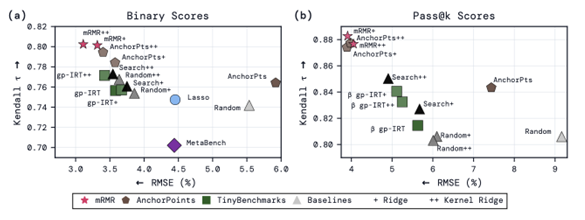
Image: Figure from Sam and Cohere co-authors’ joint paper, illustrating that their method (mRMR+/++) leads to significantly better benchmark score predictions in terms of reduced prediction error (RMSE) and increased ranking correlation (Kendall τ).
Story written by Dr Joanna Jordan