
Superheating in mafic magmas controls clinopyroxene nucleation delay and magma ascent dynamics
Bonechi B, Arzilli F, Polacci M, Fabbrizio A, La Spina G, Michailidou E, Biagioli E, Brooker R A, Hazemann J-L, Atwood R C, Di Genova D, Abeykoon S, Neave D A, Almeev R R, Burton M
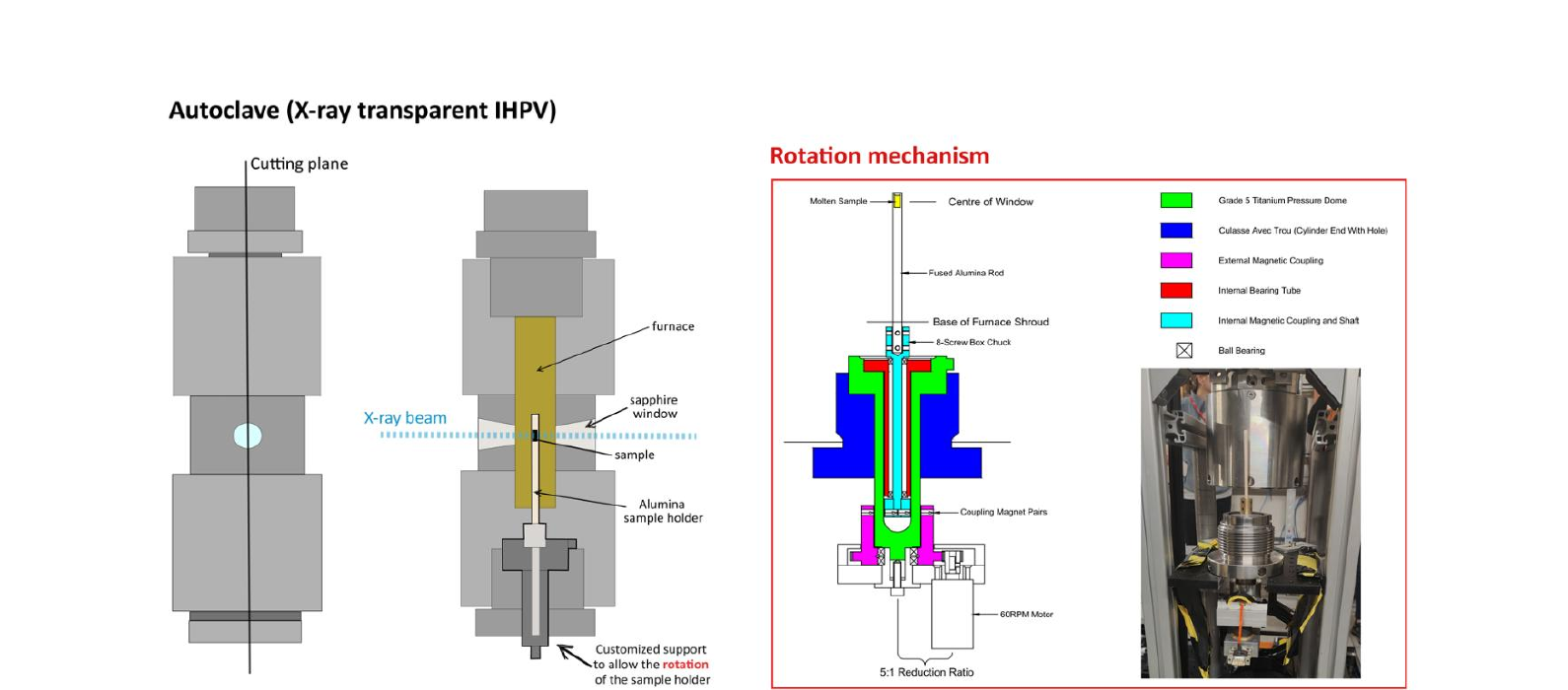
The X-ray transparent internally heated pressure vessel (T-IHPV) used for in situ 4D tomography experiments at beamline I12-JEEP, Diamond Light Source. Left: cross-section showing the X-ray beam path through sapphire windows. Right: the rotation mechanism enabling full tomographic acquisition under pressure. Adapted from Bonechi et al. (2024); CC BY 4.0.
Why do some volcanoes produce gentle lava flows while others explode violently? A new study published in Nature Communications reveals that the answer may partly lie in how hot the magma gets before it erupts.
An international team, including Petrology Group member Richard Brooker, studied tephritic magma from the 2021 Tajogaite eruption on La Palma, Canary Islands. Using the Petrology Group’s X-ray transparent internally heated pressure vessel (T-IHPV) at Diamond Light Source, they watched crystals forming in real time inside magma held at volcanic pressures — the first full 4D (3D plus time) tomography experiments from this instrument.
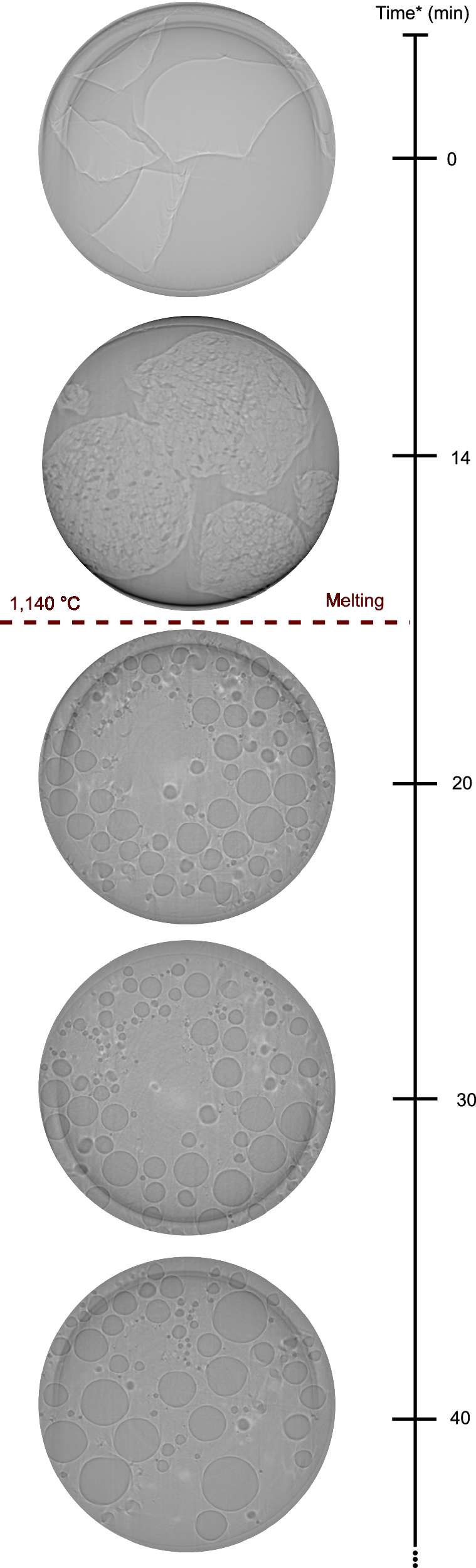
Figure 1: Real-time synchrotron X-ray tomography of the in situ experiment at 20 MPa showing the sample melting, vesiculating, and beginning to crystallise as it is cooled through the clinopyroxene liquidus. Each disc is a horizontal slice through the sample capsule at a different time step. Figure from Bonechi et al. (2026), Nature Communications; CC BY 4.0.
The key finding: “superheating” — heating magma above the temperature at which crystals are stable — dissolves the tiny crystal seeds that normally trigger new crystal growth. When the magma subsequently cools, crystallisation is dramatically delayed. Unsuperheated magma began crystallising within about 20 minutes; strongly superheated magma took more than eight hours.
This matters because crystal content controls magma viscosity, which in turn governs how fast magma rises and how easily gas can escape. Numerical models of magma ascent showed that a long crystallisation delay allows magma to stay fluid and rise rapidly, promoting dramatic lava fountaining. Shorter delays produce a more viscous, slower-rising magma from which gas escapes gradually — favouring quieter effusive eruptions.
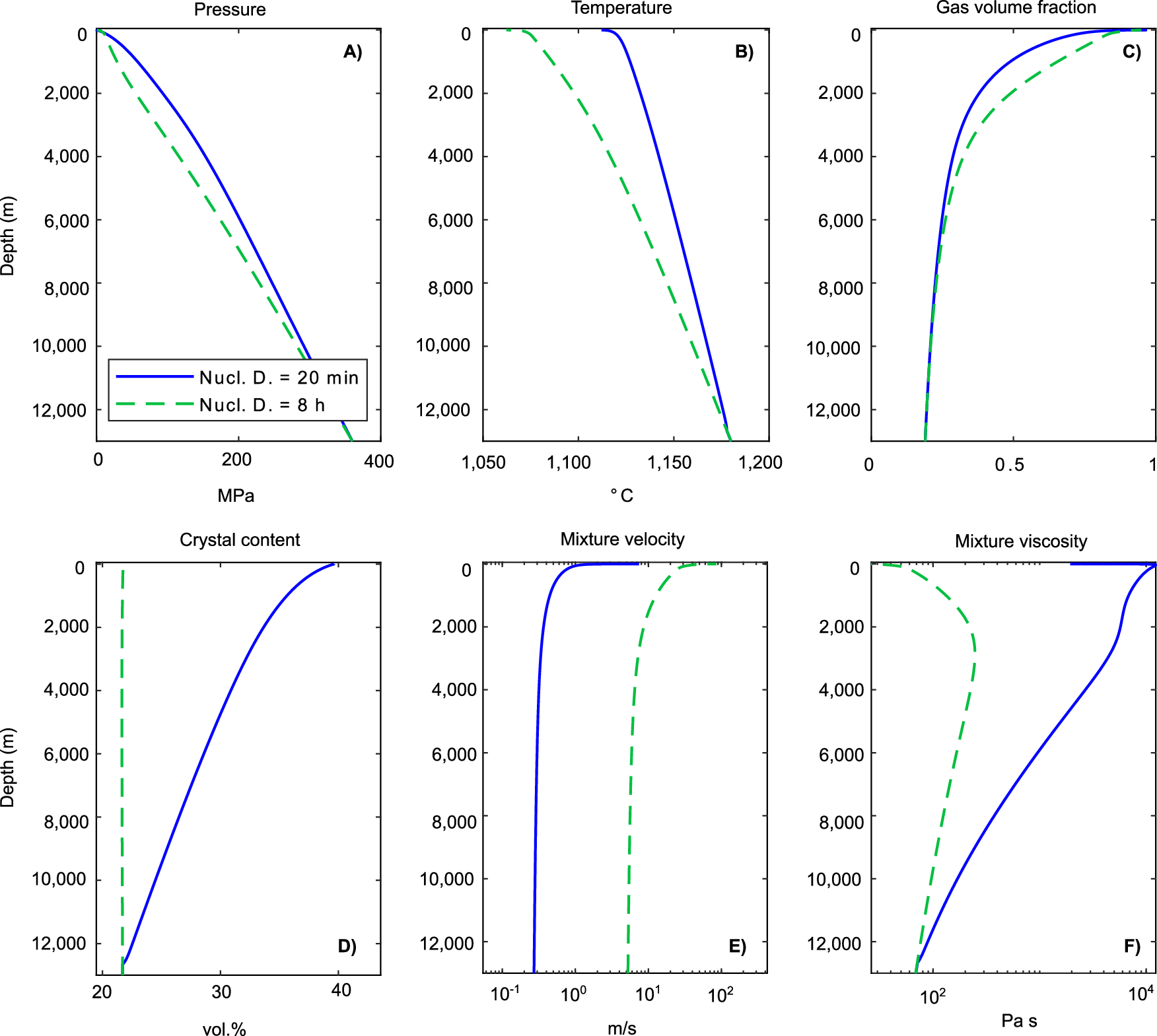
Figure 2: Numerical models of magma ascent comparing a 20-minute nucleation delay (solid blue lines) with an 8-hour delay (dashed green lines). The superheated magma rises an order of magnitude faster, with lower crystal content, lower viscosity, and higher gas fractions near the surface. Figure from Bonechi et al. (2026), Nature Communications; CC BY 4.0.
The results highlight a previously underappreciated control on eruptive behaviour: the thermal history of magma before it begins its journey to the surface. Read the full University of Manchester press release here.
Bonechi, B., Arzilli, F., Polacci, M., Fabbrizio, A., La Spina, G., Michailidou, E., Biagioli, E., Brooker, R. A., Hazemann, J.-L., Atwood, R. C., Di Genova, D., Abeykoon, S., Neave, D. A., Almeev, R. R., & Burton, M. (2026). Superheating in mafic magmas controls clinopyroxene nucleation delay and magma ascent dynamics. Nature Communications, 17, 4962. https://doi.org/10.1038/s41467-026-73352-1