
Olivine inclusions in diamond are remnants of a syngenetic monocrystal
Wincott M M, Kohn S C, Parkinson I J
Natural diamonds have been growing deep beneath the continents for at least three billion years. Those transported to the surface in rare volcanic eruptions therefore represent some of the oldest and deepest samples of the Earth, making them extremely valuable to science.
Pure diamonds are made only of carbon and so cannot reveal much about their origins — no age data, no pressure data, no chemical data. However, some diamonds contain inclusions — other minerals trapped within them — which preserve records of the physical and chemical conditions of otherwise inaccessible times and places. Whether these inclusions grew at the same time as the diamond (syngenesis) or were pre-existing minerals engulfed during growth (protogenesis) has been a long-standing debate. The distinction matters: a syngenetic inclusion directly records the conditions of diamond growth, while a protogenetic one carries prior history that may be unrelated.
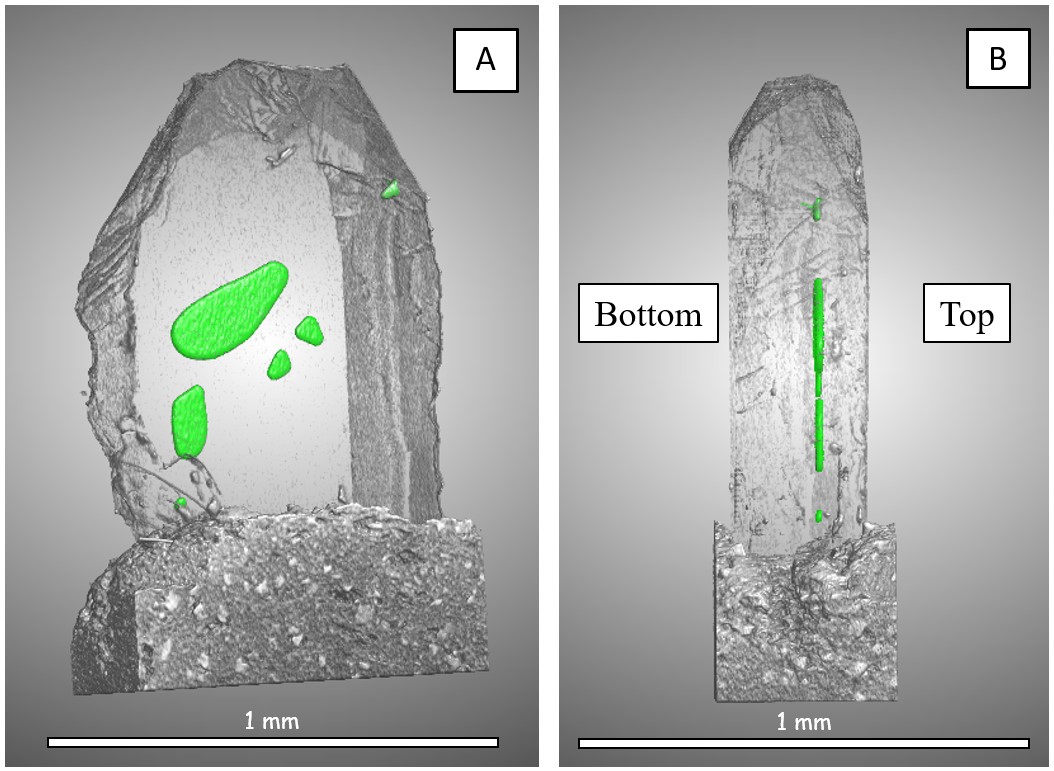 Figure 1: Micro-CT scan of the double-polished diamond fragment. The six olivine inclusions, highlighted in green, are crystallographically aligned and occupy a thin plane within the diamond. Figure from Wincott et al. (2025).
Recent work undertaken in the Petrology Labs at the University of Bristol has tackled this problem by focusing on an unusual diamond containing six olivine inclusions. Using Fourier transform infrared spectroscopy, the team identified the crystallographic orientations of the inclusions within their host, revealing them to be aligned with one another — indicating that they were once part of a larger single crystal that was partially dissolved during diamond growth. Such an observation is a classic argument in favour of protogenesis; however, when studied further, the full story proved more nuanced.
Micro-CT scanning revealed that all six inclusions are thin and aligned in a narrow plane, and cathodoluminescence imaging with a scanning electron microscope showed this plane to be parallel to a diamond growth surface. Despite a short-lived dissolution phase, the positioning of the inclusions within the diamond strongly suggests that they interacted with their host during simultaneous growth.
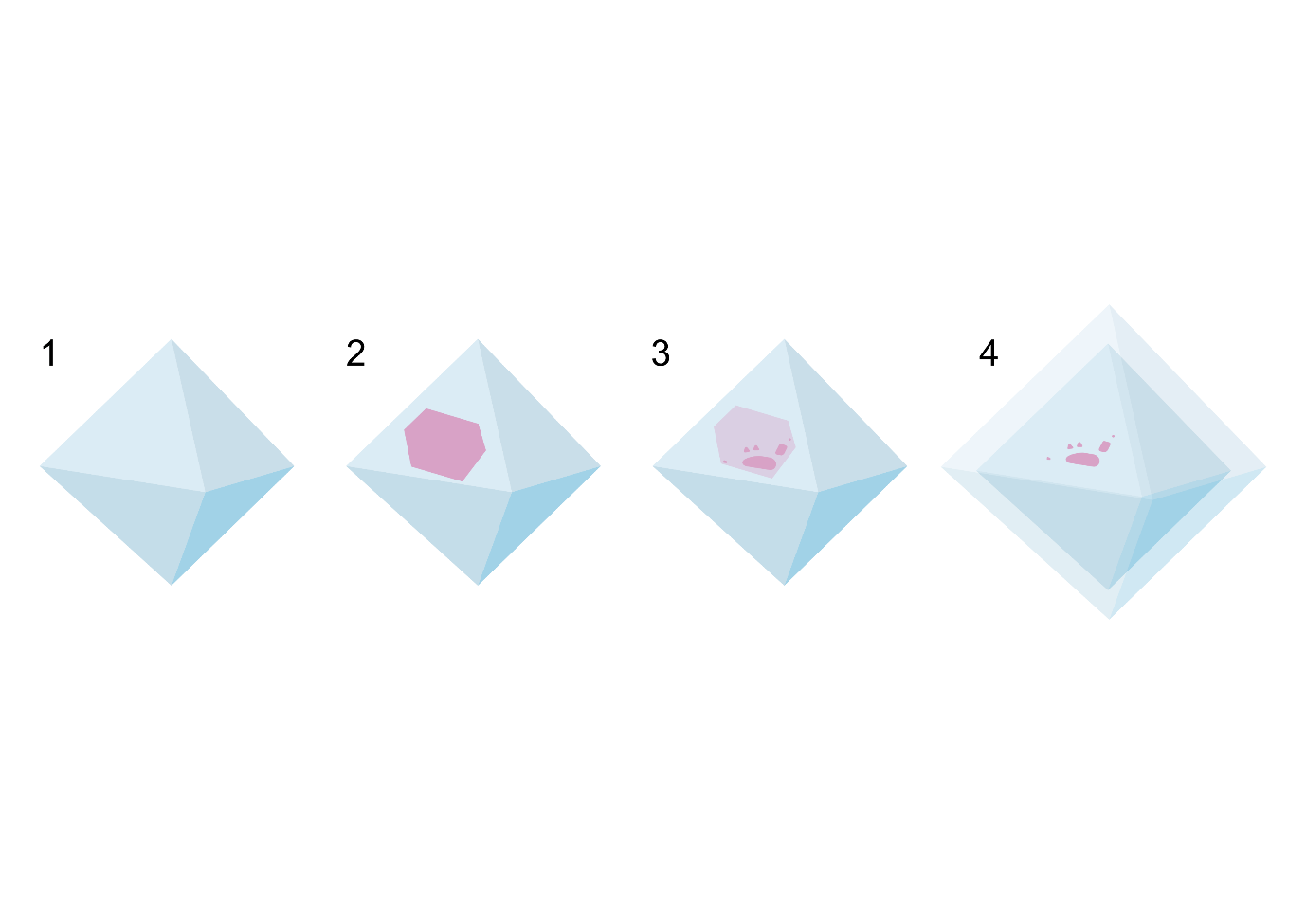 Figure 2: Growth model for the sample: (1) a diamond core grows; (2) a single crystal of olivine precipitates alongside the diamond core; (3) the olivine crystal partially dissolves and is replaced by growing diamond; (4) encapsulation of the inclusions is complete. Multiple lines of evidence suggest these phases happened in quick succession, making the relationship syngenetic despite a brief episode of olivine dissolution. Figure from Wincott et al. (2025).
These new insights demonstrate that a multi-pronged approach — combining FTIR spectroscopy, micro-CT, and cathodoluminescence imaging with instruments available at the University of Bristol — is required to fully capture the processes at play in diamond–inclusion relationships.
Wincott, M. M., Kohn, S. C., & Parkinson, I. J. (2025). Six olivine inclusions in diamond are remnants of a syngenetic monocrystal. Lithos, 496–497, 107953. https://doi.org/10.1016/j.lithos.2025.107953