
The structure of liquid mercury at high pressure
Drewitt J W E, Heinen B J, Rogmann E-M, Lord O T, Turci F, Barnes A C, Wilson C W, Macleod S G, Kleppe A K
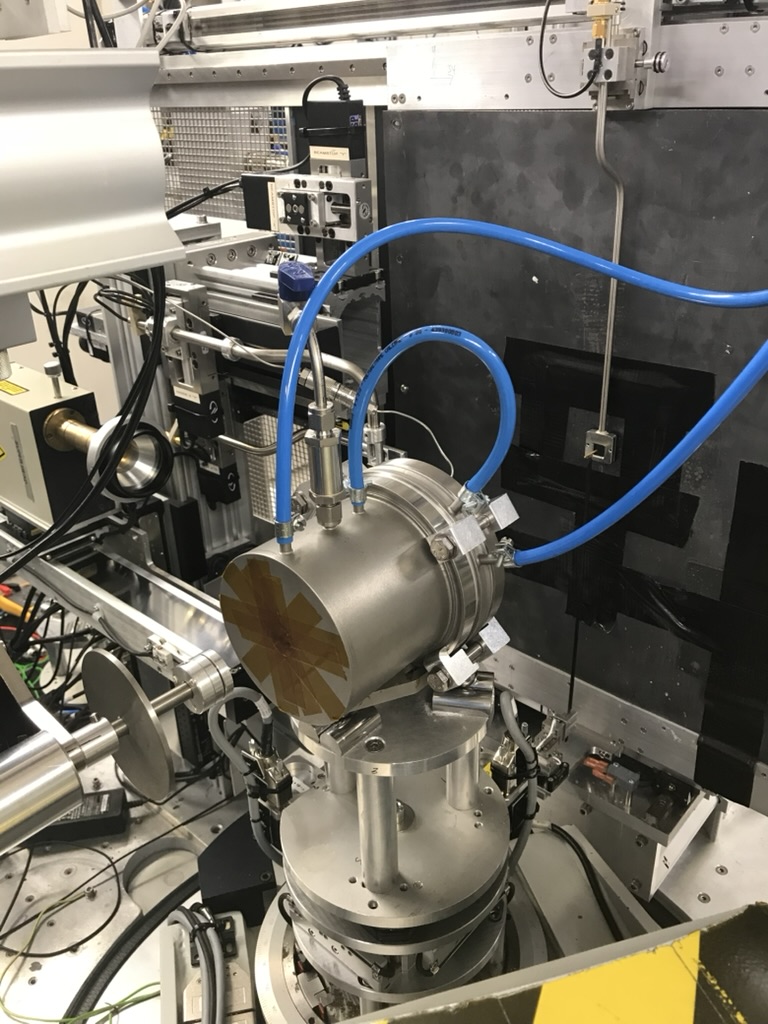
The externally heated diamond anvil cell mounted at beamline I15, Diamond Light Source, UK.
Mercury is the only metal that is liquid at ambient conditions and the first element found to exhibit superconductivity. When expanded towards its liquid–vapour critical point it undergoes a dramatic metal–nonmetal transition. But what happens to liquid Hg when you squeeze it? Remarkably little has been known — until now.
In a new study published in Physical Review B, Petrology Group member Oliver Lord, together with collaborators in Bristol’s School of Physics and at AWE and Diamond Light Source, has used synchrotron X-ray diffraction (SXRD) in an externally heated diamond anvil cell to map out the melting curve and atomic-scale structure of liquid Hg up to 9.4 GPa and 651 K — well beyond any previous measurements. The experiments were performed at beamline I15 at Diamond Light Source, with liquid Hg loaded into a NaCl-lined chamber using a technique first developed by the group for their earlier study of liquid gallium under extreme conditions.
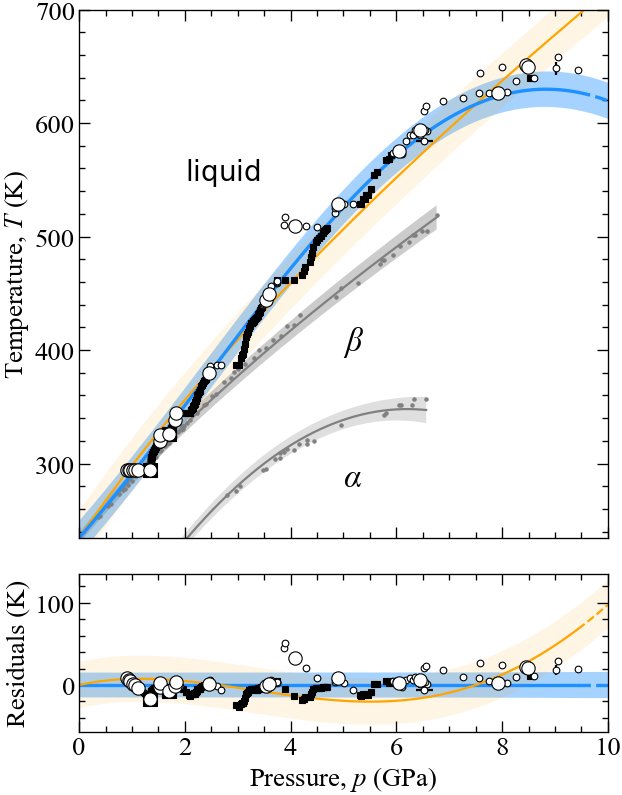
Figure 1: The high-pressure melting curve of mercury. Black squares and open circles are solid- and liquid-state measurements from this study; grey circles are literature data. The blue curve is a Kechin fit that captures the pronounced flattening and possible maximum between 6 and 9 GPa. Figure from Drewitt et al. (2026).
The melting curve shows a pronounced flattening — and possibly a maximum — between 6 and 9 GPa, suggesting that the liquid becomes denser than the solid at these conditions. This is reminiscent of the behaviour seen in anomalous metals like gallium, where the melting curve maximum is linked to complex structural reorganisation in the liquid state.
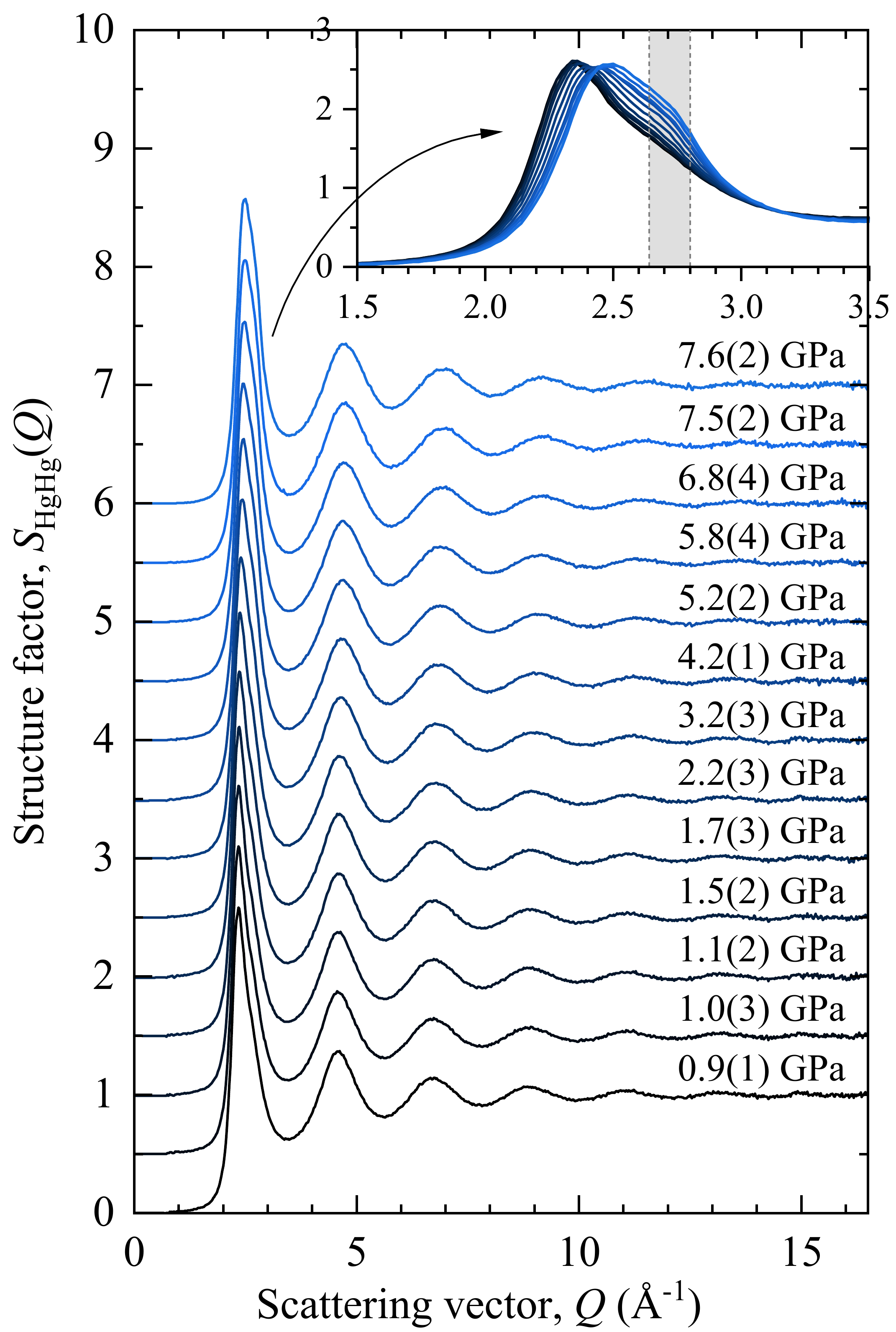
Figure 2: Structure factors S(Q) of liquid Hg measured by SXRD from 0.9 to 7.6 GPa. The principal peak shifts to higher Q under compression, indicating progressive densification. A subsidiary peak near 2kF (shaded) tracks the increasing electron density. Figure from Drewitt et al. (2026).
The SXRD data reveal a continuous structural evolution under compression: the coordination number rises from around 10 towards the hard-sphere limit of 12, and the characteristic peak ratios in both reciprocal and real space converge towards the values expected for a simple close-packed liquid. Ab initio molecular dynamics (AIMD) simulations reproduce the experimental data at equivalent reduced densities, providing confidence in extending the atomistic model beyond the experimentally accessible range.
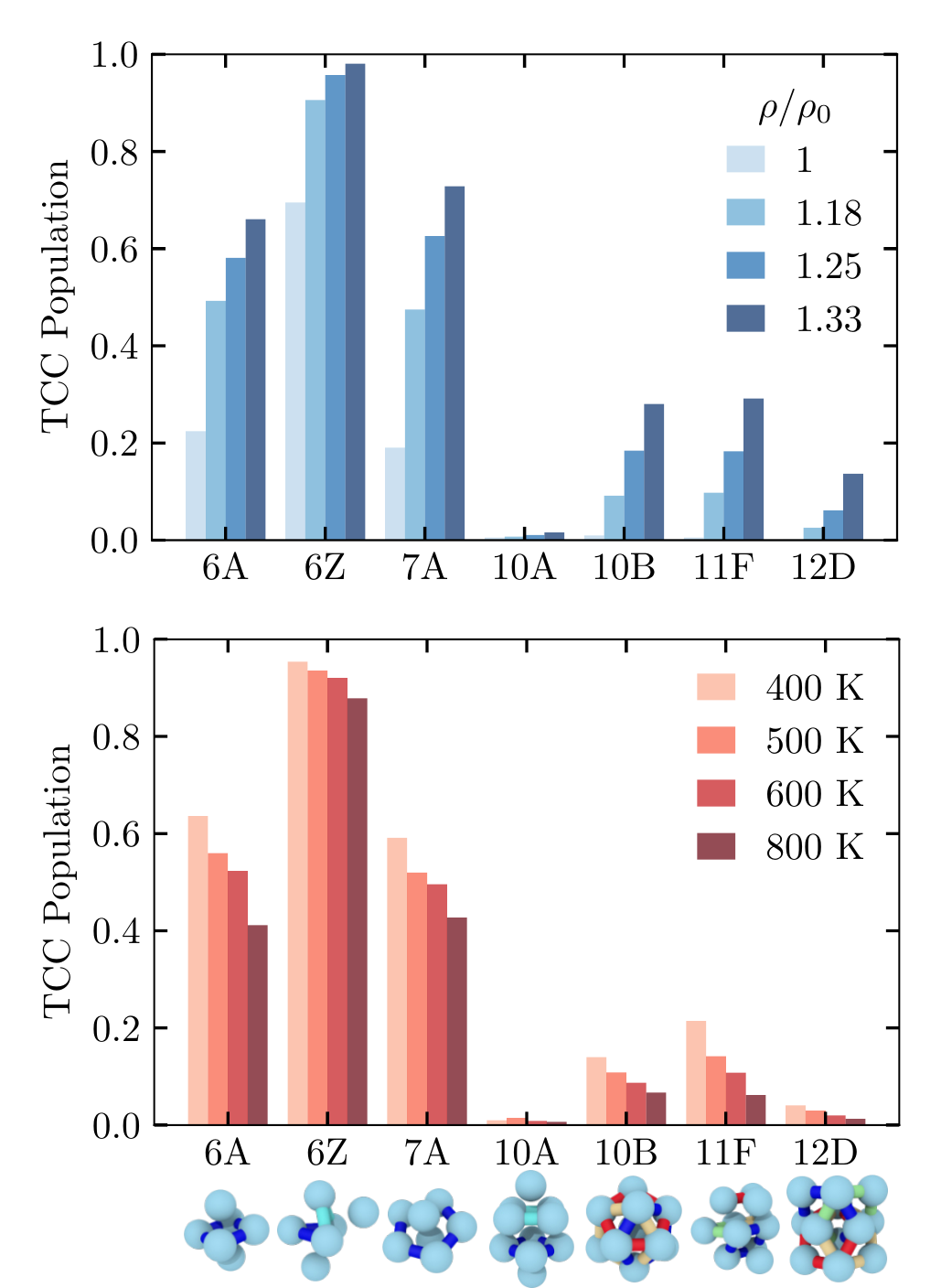
Figure 3: Topological cluster classification (TCC) analysis of the AIMD trajectories. The upper panel shows how compression at constant temperature drives an increase in the population of both simple and complex structural motifs. The lower panel shows how heating at constant density disrupts local order. Cartoon depictions of representative clusters are shown along the bottom. Figure from Drewitt et al. (2026).
But the story is not as simple as Hg becoming a generic hard-sphere liquid under pressure. Topological cluster classification analysis of the AIMD trajectories reveals that liquid Hg retains a richer population of many-body structural motifs — including five-fold symmetric clusters associated with local glass-like ordering — than a true hard-sphere system at equivalent packing fractions. These metastable, low-entropy environments may provide a structural explanation for the anomalous flattening of the melting curve, echoing the conclusions drawn from the group’s earlier work on liquid gallium.
The electronic structure also evolves dramatically: the Hg 5d density of states broadens and shifts towards the Fermi level under compression, implying enhanced d-electron scattering and increasing electrical resistivity — behaviour more akin to first-row transition metals than to a simple post-transition element.
Drewitt, J. W. E., Heinen, B. J., Rogmann, E.-M., Lord, O. T., Turci, F., Barnes, A. C., Wilson, C. W., Macleod, S. G., & Kleppe, A. K. (2026). The structure of liquid mercury at high-pressure. Physical Review B. https://doi.org/10.1103/nffz-z1g8