
Jon Goldwin
Research Interests and activities
I am an experimental physicist working with quantum light and matter. My research pursues new ways to leverage quantum phenomena for next-generation sensing and timing, with an eye towards both practical applications and more fundamental physics.
Quantum Computing
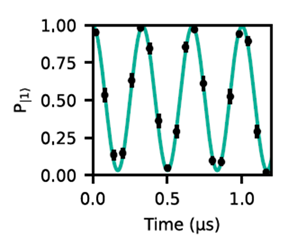
In recent years it has been shown that arrays of individual atoms can be optically trapped, cooled, and manipulated to act as qubits in quantum computers. In my work in industry, we built a universal quantum computer with individual addressing and non-destructive readout. More recently, we set a record for two-qubit entangling gate fidelity in a dual-species neutral-atom platform. This work will enable quantum error-corrected circuit operations.
Quantum Technologies
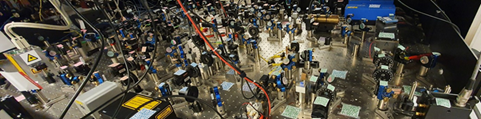
Atomic quantum systems underpin a wide range of exciting new technologies. Standout developments at the leading edge of quantum sensing and metrology include optical clocks, inertial sensors, photonic memories, and field sensors. We aim to apply the techniques of quantum information processing to build clocks and sensors with enhanced capabilities. Specifically, opportunities for exploiting quantum entanglement and error correction will be explored.
Light-matter Interactions
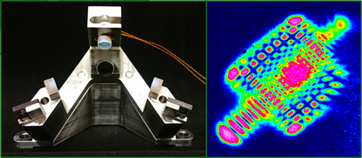
Many emerging quantum technologies rely in one way or another on interactions between atoms and light. These interactions can be enhanced by confining the atoms and light within optical cavities. My research group at the University of Birmingham built the UK’s coldest laser, with a gain medium around one thousandth of a degree above absolute zero. Using microfabricated components, it is possible to observe interactions at the level of individual atoms and photons. At Imperial College we demonstrated fast detection of single atoms in a scalable microcavity with direct waveguide coupling. At the University of Bristol, we will pursue such miniaturisation to its limits by designing and building nanophotonic components for integration with atomic systems.
A full list of my research papers can be found on Google Scholar.