
New result from the LHCb experiment challenges leading theory in physics
Bristol physicists are part of a team that has announced ‘tantalising’ results that potentially cannot be explained by our current laws of nature.

Bristol physicists are part of a team that has announced ‘tantalising’ results that potentially cannot be explained by our current laws of nature.
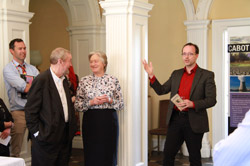
Yesterday (April 10), the University of Bristol said a fond farewell to the outgoing Chair of the Cabot Institute External Advisory Board (CIEAB), Sir John Beddington, and warmly welcomed Dame Julia Slingo to the role.
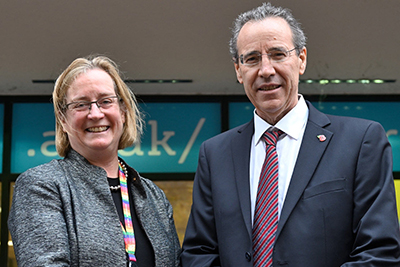
The German Ambassador to the UK, His Excellency Miguel Berger visited the University on Friday [11 November], to meet Professor Evelyn Welch, the University's Vice-Chancellor and President, to discuss opportunities for UK-Germany education and research collaboration.
World Parkinson's Disease Day [11 April] is held every year on Parkinson's birthday to raise awareness of the disease and the research being done to alleviate it. To mark 200 years since James Parkinson first identified the condition named after him, a new biography of this forgotten man has been published.

As the COVID-19 pandemic hit the world, academics from across the University of Bristol joined together to understand the virus and the impact of the pandemic. Today [23 March] is a year since the first UK lockdown and their research is continuing to play a key role in global efforts to overcome the disease.

Bristol has been given a ‘Silver’ ranking in the pilot Teaching Excellence Framework (TEF), which was published on 22 June 2017.
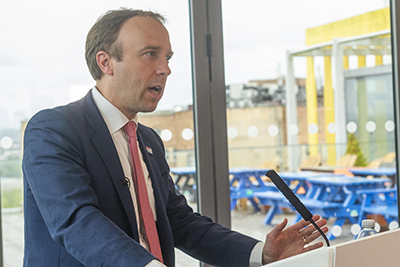
The Secretary of State for Health and Social Care, the Rt. Hon. Matt Hancock MP, today [25 May] visited the University of Bristol for the official launch of a new Pfizer Centre of Excellence for Epidemiology of Vaccine-preventable Diseases.

How Bristol addresses the local challenges – and opportunities – brought on by Brexit is the focus of a free public event on Tuesday 23 May bringing experts in immigration, trade, politics and sociology from the Universities of Bristol and West of England together in constructive dialogue with local community leaders, city officials, business people, local charities, and community activists. Mayor Marvin Rees and Vice Chancellor Hugh Brady will be in attendance to welcome participants at the day’s event.
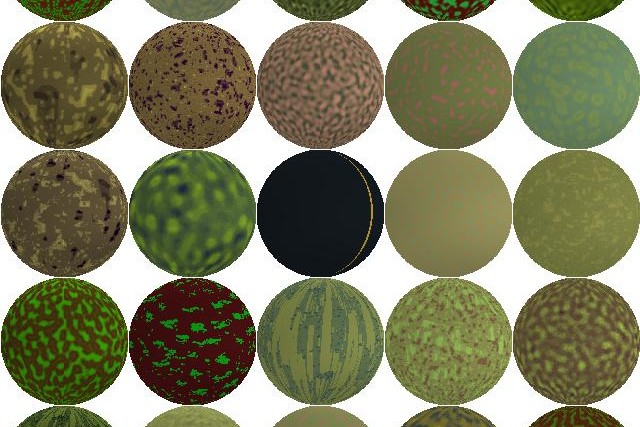
A new method, developed by scientists at the University of Bristol can determine the optimal colouration pattern to cover an object in order to make it as visible or concealed as possible, in any given environment.

Life expectancy of 20-year-olds starting treatment for HIV has increased by around a decade in the EU and North America since the introduction of antiretroviral therapy in the mid-1990s, according to a study published in The Lancet HIV. These increases are among treated individuals, and are in addition to dramatic life expectancy improvements that occurred after the introduction of antiretroviral therapy compared with untreated individuals.