
A Busy Summer for Neshika Wijewardhane
Digital Health CDT student Neshika Wijewardhane has had a busy summer! Neshika attended the Manipulation Automation Robotics of Small Scales (MARSS) Conference 2022 in Toronto, Canada this year.
Neshika published a full paper and then presented at the conference, which she detailed for us:
"The conference was 4 days long with over 200 participants at the University of Toronto. Participants included micro and nano robotistic, clinicians, engineers, and physicists, across all research careers, masters, and PhD students, to professors and industry partners. Each day started and ended with 3 plenary talks from leaders in the field with a series of parallel talks in the middle from the authors of the submitted papers. The general themes of the talks included swarm robotics, medical applications for micro-robots, automation and characterisation, and control by optical, thermal, and mechanical stimuli. I presented my paper entitled ‘Long-term Imaging and Spatio-temporal Control of Living Cells Using Light’ at a special session on ‘Optical Based Automated Micro-Manipulation’ about our robotic device ‘Dynamic Optical MicroEnviroment’ which can now visualise living cells and project light to facilitate closed-loop control of cells. Between sessions, there were breaks and lunch which lead to interesting conversations between new peers. As this was my first conference it was hugely beneficial in making new connections for future collaborations and building my network of micro/nano roboticists as well as opening my eyes to the vast amount of research being conducted in the field. I also had the opportunity to explore the beautiful city of Toronto and Niagara Falls."
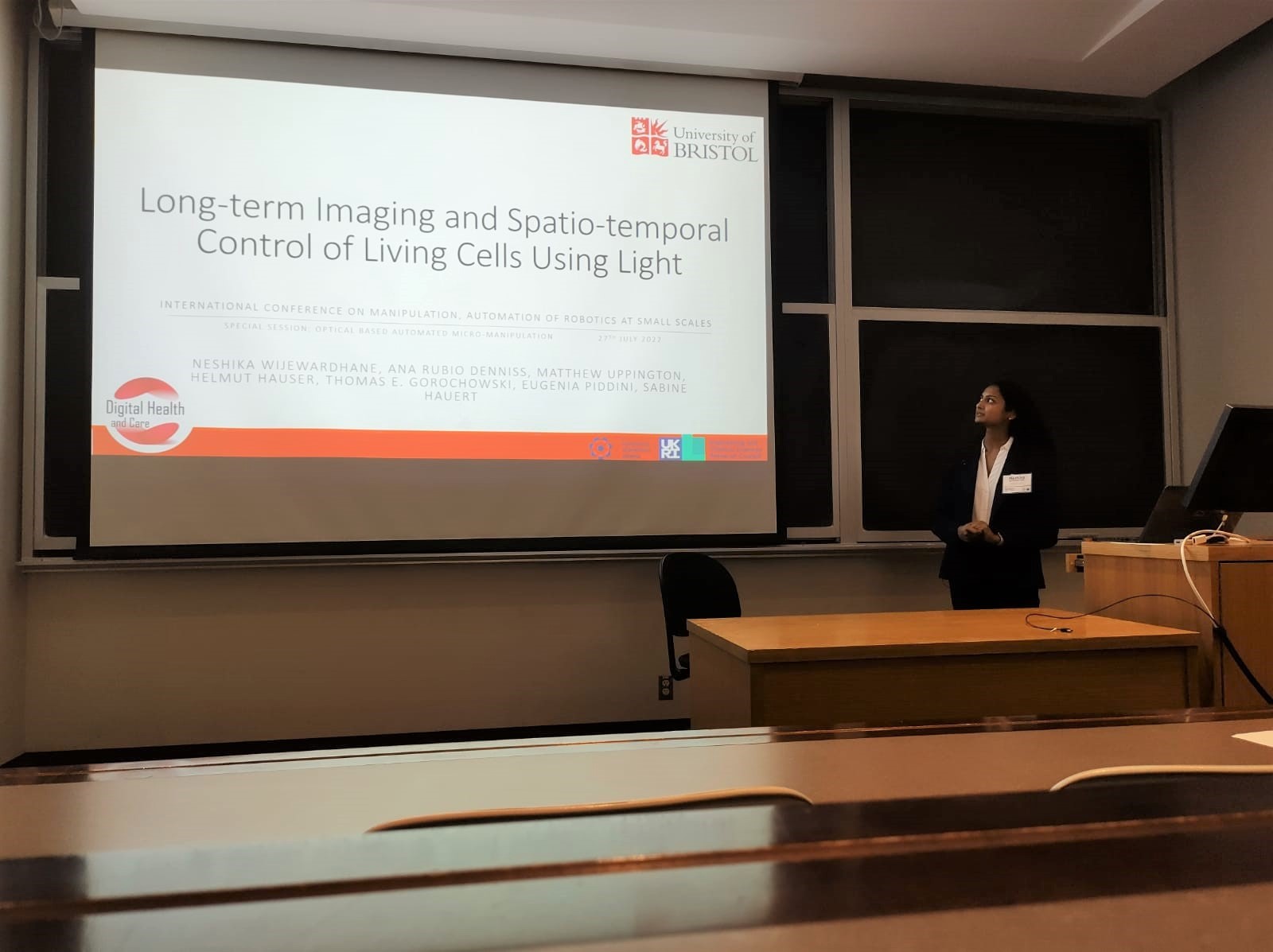
What Neshika has to say about the paper:
"The ability to optically interact with cells on both an individual and collective level has applications from wound healing to cancer treatment. Building systems which can facilitate both localised light illumination and visualisation of cells can however, be challenging and costly. This work takes the DOME, an existing platform for the closed-loop optical control of microscale agents, and adapts the design to support live-cell imaging. Through modifications made to the imaging and projection systems within the DOME, a significantly higher imaging resolution is achieved as well as the ability to customise the light projection wavelengths. Changes to the fundamental design allow for long-term use in an environment of higher temperature and humidity, facilitating the long-term imaging of live cells.
The Dynamic Optical MicroEnviroment (DOME) robotic device is now able to visualise living cells to aid the control of cells using light. This allows us to implement different light patterns and regimes in a closed-loop manner to initiate different cellular dynamics such as cell migration and thus opens the possibilities for treatments in the fields of wound healing specifically but also in cancer and anti-microbial therapy."
Neshika's paper has now been published in IEEE Explore and can be found here:
Wijewardhane, N., Denniss, A., Uppington, M., Hauser, H., Gorochowski, T., Piddini, E. and Hauert, S., 2022. Long-term imaging and spatio-temporal control of living cells using light. 2022 International Conference on Manipulation, Automation and Robotics at Small Scales (MARSS), pp.1-6. https://ieeexplore.ieee.org/document/9870487