
SPHERE WP4: Remote powering of body-worn sensors
SPHERE stands for “a Sensor Platform for Healthcare in a Residential Environment”, and is a £12M EPSRC Interdisciplinary Research Collaboration led by the University of Bristol, whose collaborators include Southampton and Reading Universities.
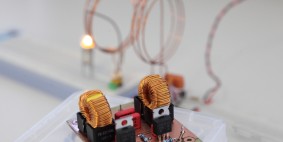
Inductive power transfer between coils
The chief aim of SPHERE is to develop technology that will aid early diagnosis at home, support people undergoing a lifestyle change, and help patients to live at home.
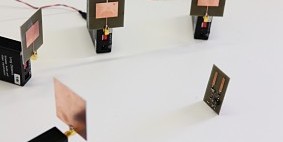
Radio-frequency power transfer from 4 transmitters to a wireless sensor
Our approach is not to develop fundamentally-new sensor technology specifically for individual disease conditions, but rather to impact a range of healthcare needs simultaneously by employing data-fusion and pattern-recognition from a common platform of largely non-medical or environmental networked sensors in a home environment.
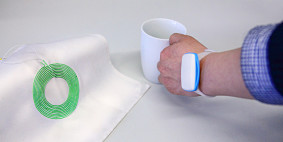
Textile coil for inductive power transfer
This page refers to a work package within SPHERE that is investigating methods for powering autonomous body-worn healthcare devices. The material science is being carried out at Southampton University, and antenna design, power electronics, and low-power systems work is carried out in the Electrical Energy Management Research Group at Bristol University.
We are investigating a number of functional materials and the associated power electronics:
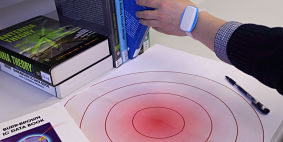
Wireless, medium-range power zone
Inductive power transfer
Our domestic application is challenging as it implies getting power to moving targets, where there is a low magnetic coupling between coils, and where the coils' quality factors are low due to the use of textile and miniaturised coils. We have shown in the lab how to obtain sufficient power transfer levels whilst respecting the strictest exposure limits proposed by ICNIRP. We are currently exploring how to adapt designs to real domestic daily routines.
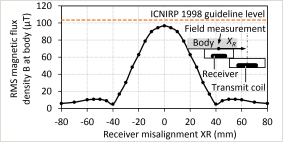
Magnetic field vs receiver misalignment
One such prototype is a kit that allows the user to set up convenient "power zones" in which their devices are charged whilst being worn. It uses a large area textile coils, a Class D coil-driver, and switched-mode power-conditioning that provides regulated d.c. and energy storage.
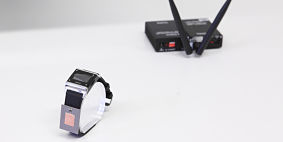
High-efficiency antenna for smart watch
2.45 GHz RF power transfer
In theory, power can be radiated to devices by wireless routers. The integration of this concept into body-worn products is challenging: the received power varies rapidly over a range of microwatts to milliwatts, depending on the movement of the receiver, and antenna designs that are optimised for efficiency are generally too large and rigid for body worn applications. We are developing increasingly smaller and more efficient rectifying antennas for smart watches, and the associated ultra-low power electronic system to provide continuous power to a sensor.
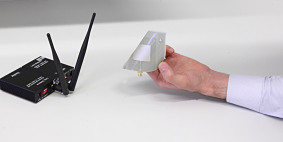
Flexible radio-frequency (2.45 GHz) textile antenna
Textile antennas would increase flexibility and comfort, and give designers the ability to integrate large area antennas into garments, furniture, and other items in the user’s environment. We are investigating how to make materials that provide both the mechanical and electrical properties required. For example we have characterised the electrical losses of numerous commercial textiles and other flexible materials, in order to produce a suitable composite structure.
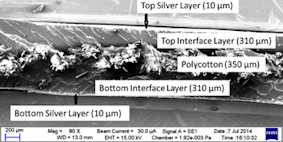
Cross-section of textile antenna
The textile antenna shown to the right was fabricated using screen printing. This technology is low cost, simple and suitable for patch fabrication. The fabric substrate is PES/cotton (65/35) which is widely used in the garment industry. As the fabric surface is rough and not suitable for direct deposition of conductive layers, an interface layer using UV-curable ink was printed onto the fabric surface, to reduce surface roughness.
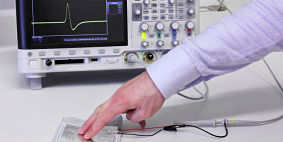
A pulse generated by a ferroelectret energy harvester
Textile energy harvesters
We are developing ferroelectret and triboelectric textiles that generate a voltage when compressed or bent. This voltage only lasts for milliseconds, and therefore only around 1 μJ is available per harvesting event. These μJ events need to be accumulated in order to power up a sensor intermittently. This process is carried out by a power management circuit. A significant technical challenge that we are currently investigating is how to activate power management circuity precisely when a pulse occurs, but without spending power on pulse monitoring circuits. Also, once a pulse is detected, the power management needs to operate with sub-microwatt conversion losses, and optimally load the energy harvester during the very short pulse period.
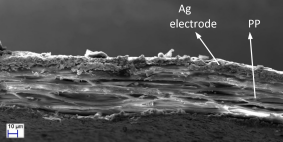
Cross-section of ferroelectret foam energy harvester
The ferroelectret harvester textiles are manufactured from cellular polypropylene (PP), in order to contain cells fixed electrical charges. When the cells are compressed, the distance between charges changes and an electric field is produced. This field drives a current pulse through silver contacts to external circuits. We have constructed several prototypes integrated into clothing, including multi-layer insoles that generate over 50 μJ per step.
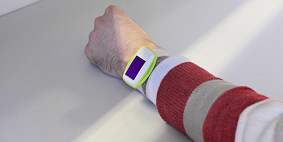
Potential application of photovoltaic fabrics
Photovoltaic textiles
We are investigating the printing of photovoltaic inks onto textiles and flexible materials for use in body-worn applications. The challenge of working with non-planar and flexible materials is substantial, and a lot of work is needed to get this to the stage where it could be applied. We have created intact organic cells on woven textiles, albeit of low efficiency. The goal is to obtain textiles that power wearable sensors from natural and artificial indoor lighting.
Project publications
- S. Adami, D. Zhu, Y. Li, E. Mellios, B. H. Stark, S. Beeby, “A 2.45 GHz Rectenna Screen-Printed on Polycotton for On-Body RF Power Transfer and Harvesting,” IEEE Wireless Power Transfer Conference, Boulder, USA, 2015.
- L. R. Clare, P. Worgan, B. H. Stark, D. Coyle, “Influence of Exposure Guidelines on the Design of On-Body Inductive Power Transfer,” IEEE Wireless Power Transfer Conference, Boulder, USA, 2015.
- D. Zhu, N. J. Grabham, L. Clare, B. H. Stark, S. P. Beeby, “Inductive Power Transfer in E-Textile Applications: Reducing the Effects of Coil Misalignment,” IEEE Wireless Power Transfer Conference, Boulder, USA, 2015.
- P. Worgan, L. R. Clare, B. H. Stark, P. Proynov and D. Coyle, “Inductive Power Transfer for On-body Sensors. Defining a design space for safe, wirelessly powered on-body health sensors”, Pervasive Health, Istanbul, 2015.
- Z. Luo, D. Zhu, J. Shi, S. Beeby, C. Zhang, P. Proynov, B. H. Stark, “Energy harvesting study on single and multilayer ferroelectret foams under compressive force”, IEEE Transactions on Dielectrics and Electrical Insulation, in press, 2015.
- Z. Luo, D. Zhu, J. Shi and S.P. Beeby 2014, "Energy Harvesting Study on Single and Multilayer Ferroelectret Foams under Compressive Force," IEEE 15th International Symposium on Electrets, August 11-13, 2014, Baltimore, USA.
- S-E Adami, P. P. Proynov, B. H. Stark, G. S. Hilton and I. J. Craddock , “Case Study of RF Energy Transfer System in Indoor Environment”, PowerMEMS 2014.
- P. Proynov, B. H. Stark and J. N. McNeill, “Low-power Methods of Power Sensing and Frequency Detection for Wideband Vibration Energy Harvesting”, PowerMEMS 2014.
- G. Yang, B. H. Stark, S. J. Hollis and S. G. Burrow, “Optimization of Passive Voltage Multipliers for Fast Start-up and Multi-voltage Power Supplies in Electromagnetic Energy Harvesting Systems”, PowerMEMS 2014.