
What can Greek mythology, theatre, and coding learn from each other?
Lucy Ruddiman is a PhD Candidate in the Department of Theatre at the University of Bristol. Her research explores the modern performance of Greek tragedy as a site where different forms of knowledge are brought into contact with each other.
What can Greek mythology, theatre, and coding learn from each other?
This is the question which we began to address in ‘Magic from Myth: Theatre and Coding Workshop’. This Centre for Creative Technologies Seedcorn-funded project was a collaboration amongst the Bristol Digital Game Lab, the Pervasive Media Studio and theatre company Actors of Dionysus. It consisted of a one-day workshop exploring the intersections of classical myth, theatre, and digital game-making. The workshop aimed to explore how bringing these different areas of knowledge together in a playful atmosphere might highlight commonalties and tensions amongst them and enrich our collective understanding of each area.
The workshop was divided into two sections. The first section was a performance and storytelling workshop exploring classical myth, delivered by Actors of Dionysus’ Artistic Director, Tamsin Shasha, and Education Officer, Mark Katz. The second section was co-delivered by Actors of Dionysus and Pervasive Media Studio Residents Eleanor Edwards and Ant Nascè and used the myths explored in the first section as the basis for an introduction to coding.
Myth and Theatre
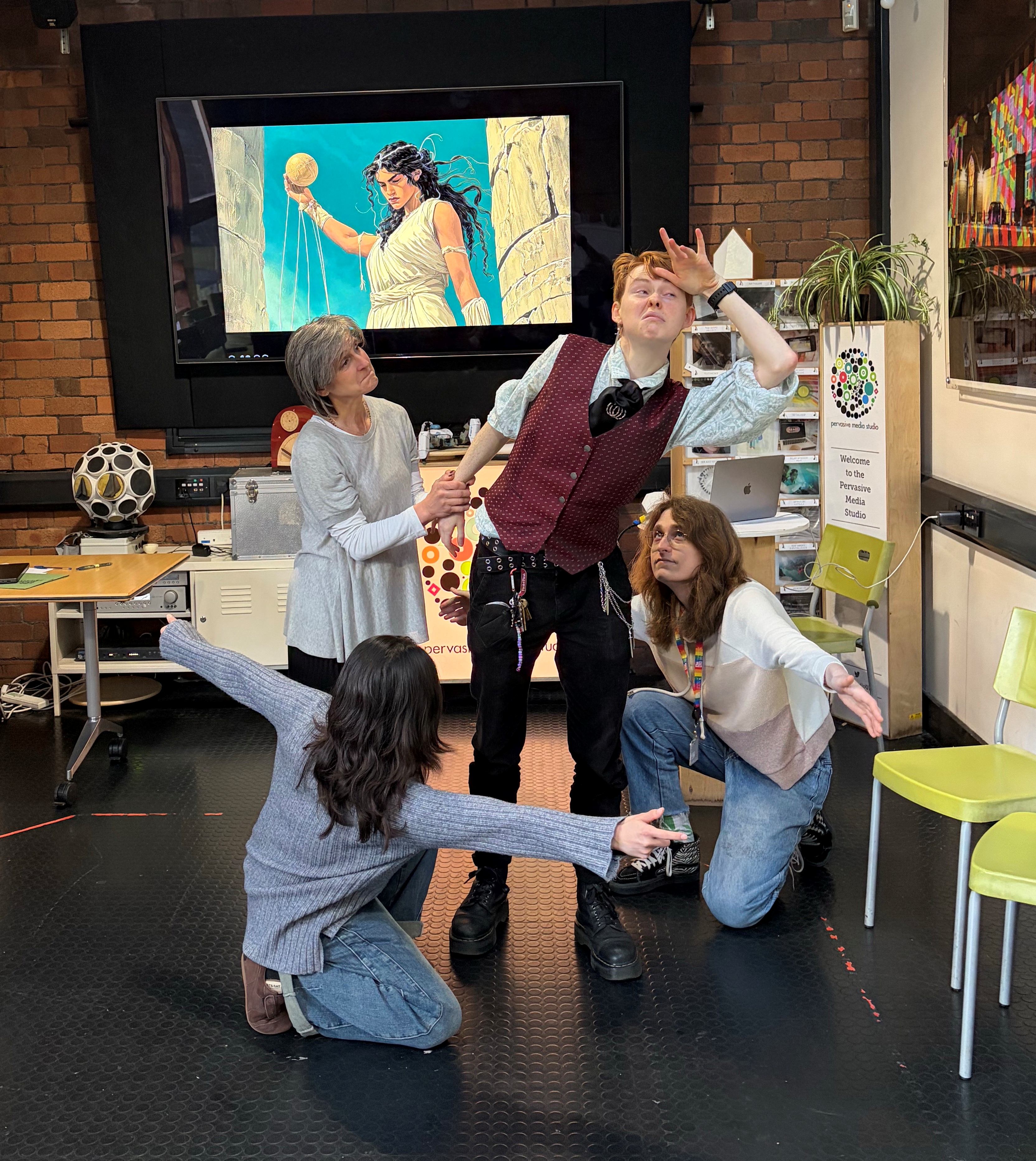
The first section began by exploring the myth of Theseus, Ariadne and the Minotaur. We told this story together in a circle, describing how the Athenian prince, Theseus, volunteered to kill the Minotaur in its labyrinth beneath the palace of Crete and how he was able to succeed with the help of the Cretan princess, Ariadne, whom he then abandoned on the island of Naxos. Participants were then tasked with presenting key moments from the myth as a series of tableaux, which required them to simultaneously decide which elements of the story they found most significant and how they should be physically represented.
The next myth we explored was the story of Atalanta: a princess who was abandoned in the wilderness and raised by a she-bear, sailed with Jason and the Argonauts and defeated the monstrous Calydonian Boar. Actors of Dionysus presented this myth as a scripted story which participants were invited to join by embodying different characters. The participants were generally less familiar with this myth, meaning that many discovered the story through enacting it. This impacted how the myth’s ending was experienced. Having set herself against marriage, Atalanta declared that she would only marry a man who could beat her in a footrace. One of her suitors asked Aphrodite to help him and the goddess gave him three golden apples. He threw these apples into Atalanta’s path as she ran and she was compelled to slow down to pick them up, allowing him to win the race and marry her against her will. Participants expressed a strong sense of surprise and disappointment with this ending.
Myth and Coding
In the second section of the workshop participants were supported to use Scratch to make digital games inspired by these myths. One participant was inspired by Atalanta’s footrace and created a game where the player clicked to throw golden apples to slow down the men racing against Atalanta, enabling her to win the race and escape marriage. Another participant created a two-player game where players chased each other around a maze as Theseus and the Minotaur, until Theseus either escaped or was caught and killed by the Minotaur. These games used player mechanics to perform subversions of the mythic narratives which we had been exploring through performance.
Participant Comments
‘I feel more confident in my knowledge about some elements of Greek mythology and theatre performance. The coding part of the workshop was way less intimidating than what I had imagined.’
‘There's so much potential for exploring the intersections between theatre and video games: How is a video game like a performance? How is the player like a performer? How can we use tools learned in theatre spaces to create atmosphere and experience in video games?’