
The Rapid Rise of Transnational Repression in the UK: Lessons for Government
Transnational repression – when states intimidate, silence or otherwise harm their citizens abroad – is an increasing threat in the UK. Foreign dissidents, journalists, activists and disaspora communities have faced harassment, assault, legal intimidation and, in some cases, kidnapping and assassinations on British soil.
About the research
This research explores the scale, nature and evolving forms of transnational repression in the UK. In 2022, the government established a Defending Democracy Taskforce to respond to the growing global diffusion of authoritarian practices. However, a 2025 Parliamentary Inquiry identified a lack of ‘clear data on the scale and nature of transnational repression events in the UK’. This evidence gap undermines the UK’s capacity to monitor, assess and respond to the threat. Our team between Bristol and Oxford answered the Inquiry’s call for more data on the issue. We spent nine months building the first dataset of transnational repression in the UK.
Our dataset captures the most visible transnational repression acts – assassinations and kidnappings, credible threats, assaults, legal harassment, unlawful deportation, renditions and detentions. We focused on these incident types as they leave more institutional traces and media attention than harder to observe ones like digital transnational repression. We examined the frequency of cases, the victim/perpetrator profiles and targeting patterns and localities. The dataset is built on our analysis of thousands of local and national UK news articles, NGO reports and government archives.
Policy recommendations
- The UK government should treat transnational repression as more than a form of hostile state interference. A more comprehensive framing is required around its broader threat to citizens, freedoms, institutions, and democracy in Britain.
- Central and local government should develop a community-centred approach to transnational repression, proactively building awareness amongst at-risk groups (e.g. diaspora groups from Hong Kong) and signposting government guidance and support.
- The UK government should establish a dedicated hotline for transnational repression. This would provide short-term guidance as well as longer-term support to victims through clear and public follow-up protocols and also help collect data about ongoing threats.
- There is a need for a dedicated commission on transnational repression that could work alongside existing structures while giving this issue more sustained visibility and focus. It could also liaise with civil society, train practitioners, and engage with foreign consulates in the UK.
Key findings
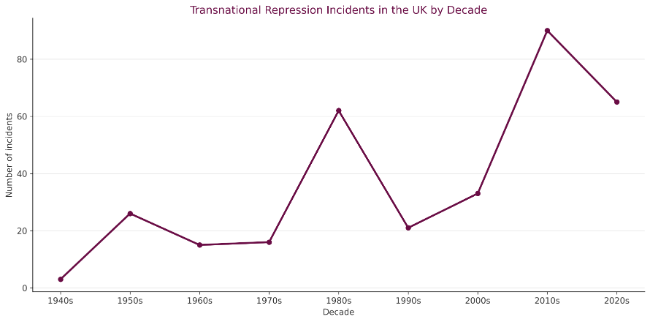
- Transnational repression in the UK is a larger and longer-running threat than often assumed. We identify over 331 incidents of transnational repression on UK soil since 1945 resulting in over 2,275 victims. The attacks came in two waves – a first in the 1980s, followed by another sharp and sustained rise from the 2010s until today.
- Transnational repression is not just a ‘hostile states’ problem. Top perpetrators include Iran and Russia, but up to a third of incidents are committed by governments with which the UK maintains strong relationships, like China, Saudi Arabia, Pakistan, India and Rwanda.
- Most targets are not well-identified elite defectors. While a common perception is that transnational repression is primarily aimed at highly visible defectors (e.g. oligarchs, senior political or military insiders), they are not the majority targets. Over two thirds of the victims are less visible activists, human rights defenders, journalists and students. Transnational repression is about shaping diaspora political space and signalling that critical political engagement – even from abroad – is not acceptable.
- The problem extends well beyond London. Our data shows that, while attacks in London account for the majority of cases, roughly 37% of incidents occur elsewhere. These cluster around sites of diaspora settlements such as Manchester, West Yorkshire and Birmingham, consistent with the goal of diaspora intimidation and management.
- Mass incidents have become more common. Recent years show episodic spikes in indiscriminate attacks aimed at broader groups (e.g. protesters), consistent with the adoption of collective intimidation as a strategic tool.
- Tactics are shifting towards less costly and more deniable forms of repression. Our data shows a decline in high-cost, high-visibility tactics such as assassinations or kidnappings, and a rise in credible threats and legal harassment. These forms of repression look ambiguous or procedural, in spite of their persistent ‘chilling effect’, suggesting transnational repression has become more diffuse and therefore harder to detect and address.
The researchers
Raphaël Lefèvre, Senior Lecturer in International Relations, University of Bristol
Anne Wolf, Fellow of All Souls College, University of Oxford
Lily Green, DPhil Candidate, Department of Politics and International Relations, University of Oxford
Further information
Lefèvre, R., Wolf, A. and Green, L. “The Rapid Rise of Transnational Repression in the UK: Lessons for Government”. University of Bristol, Policy Briefing 190, April 2026.
This project has been funded by SALIENT - Building a Secure And Resilient World