
The geographies of ‘clean energy’ jobs in Great Britain remains uneven
In this briefing, we present findings from a project that mapped online job adverts for ‘clean energy’ jobs. In doing so, we trace the existing national geographies of these opportunities to highly key sites where the economic benefits of the renewable energy transition are taking shape.
About the research
Net zero will transform the UK’s economy. It is expected that this transition will create between 135,000 to 725,000 net new jobs by 2030. While this will take shape across various sectors, the growth of the ‘clean energy’ sector has been, in particular, positioned as a key route for economic growth and job creation. The sector is one of the eight primary sectors prioritised in the 2025 Industrial Strategy.
A ‘clean energy’ job is one that supports the renewable energy transition – be it in manufacturing, installation, operations or maintenance. These roles include work in renewables, energy efficiency, and other low-carbon energy sectors. The UK Government released its Clean Energy Jobs Plan in October 2025, emphasising how these roles will grow rapidly and bring benefits to communities across the UK.
As this plan is implemented, it is necessary to trace and understand how the emergence of these new roles and their benefits will have particular geographic dimensions: clustering in certain places while remaining relatively absent in others . In particular, our work shows that these new roles are clustering in larger cities and often relatively absent in smaller, post-industrial towns.
Understanding these geographies is essential to ensuring place-based policy frameworks that ensure that mitigate economic impacts, ensure regional benefits, and support those looking for new work.
Key findings
In this research, we assessed the growth of ‘clean energy’ jobs in Great Britain through analysing online job adverts posted on the Adzuna database between 2017 and 2024. We processed this data using ‘clean energy’ keywords derived from the Lightcast Open Skill Taxonomy, searching both job titles and role descriptions. This determines the location of ‘clean energy’ jobs by Local Authority, as well as the share of these roles in the total number of jobs advertised in these places each year.
This work has identified the 30 Local Authorities that are witnessing the highest numbers in clean energy jobs in Great Britain in 2024. Over half of the clean energy job roles advertised in 2024 were in these places. These are shown in Table 1 and Map 1.
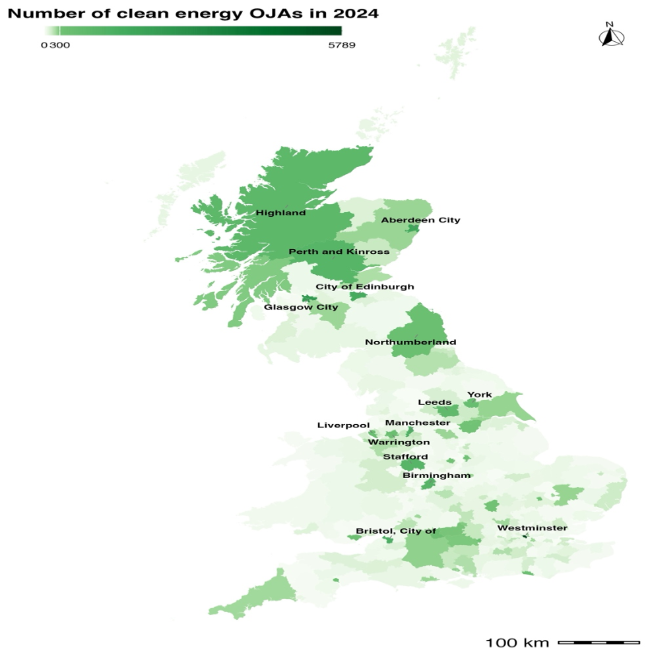 Map 1: Local Authorities by number of clean energy jobs, 2024
Key themes include:
1. Clean energy job numbers are clustered in big cities and existing centres of innovation. Of the top 30 Local Authorities identified, 17 are places highlighted as existing innovation clusters by the Department for Science, Innovation and Technologies’ ‘Innovation Cluster Map’.
These include places identified as innovation centres for multiple sectors targeted by national industrial strategy: such as London, Cambridge, Manchester, and Glasgow. It also includes regional centres for innovation that have expertise in specific sectors (such as Liverpool, Leeds, and Cardiff) and smaller scale but existing industrial clusters (Aberdeen) or university towns (York and Exeter).
2. While some old industrial towns are emerging as new clean energy hotspots, this growth is uneven. Previous research has highlighted old industrial towns as key places vulnerable to the negative economic impacts of net zero and these places have been highlighted in national policy as priority sites of new investment.
The presence of some former industrial centres in the top 30 above highlights that some old industrial towns. Doncaster and Derby are successfully growing clean energy industries through existing capabilities and supply chains. Stafford (8th) is a strong example of this: being neither a DSIT-flagged innovation cluster nor a big city but posting a high number and share of clean energy jobs in 2024.
Many ‘old industrial towns’ - such as Middlesbrough, Sunderland and Walsall – all posted relatively low levels of clean energy jobs adverts, highlighting an important absence in the national geographies of these roles.
3. The key region for current clean energy jobs is Scotland. Of the top 30 Local Authorities identified, six are found in Scotland. Four are found in the top 10. The local authorities highlighted include major cities (Glasgow, Edinburgh) and rural and coastal areas (Highland, Argyll & Bute). Aberdeen City (3rd) is a long-standing hub for oil and gas exploration in the North Sea and is a key site of the pivot to renewables.
Taken together, these Local Authorities highlight an emergent green economy that extends across the various geographies of the devolved nation. Scotland, an established energy production hub, represents a significant site of clean energy jobs in Great Britain through a combination of the roll-out of renewables, active policy by the Scottish Government, and existing innovation anchors, infrastructure and industrial capacities.
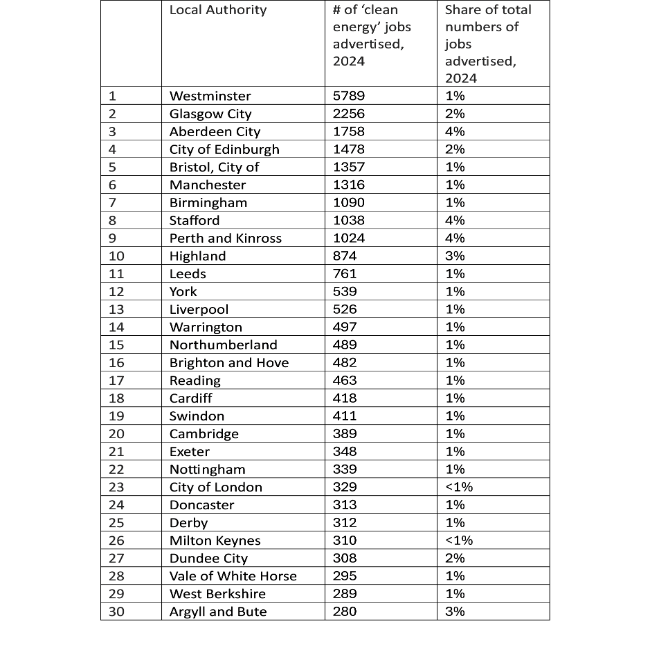
Table 1: Local Authorities by number of clean energy jobs, 2024
Policy implications
While national net zero policies are necessary, our work highlights that the shift to a green economy risks reinforcing existing regional inequalities. Data shows that clean energy jobs are disproportionately clustering in areas that hold existing economic strengths: such as large cities and innovation centres. This illuminates important policy lessons:
- Active policy is required to ensure that a transition to clean energy will be a ‘just’ one: While it can often be assumed moves to green economy will redistribute clean energy jobs opportunities, our data shows that it is, instead, benefitting those places that are already economic ‘winners’.
- The implementation of the UK Clean Energy Jobs Plans must draw on early ‘success stories of transition’ to inform new, targeted interventions in those places that are yet to experience similar growth. With the hotspots for green energy jobs primarily being larger cities and Local Authorities in Scotland, it is notable that many old industrial towns in the Midlands and North of England are absent. Success stories, such as Stafford, highlight how former industrial areas can see new clean energy jobs through leveraging and pivoting existing economic strengths.
- Policymakers elsewhere should look to the strength of Scotland’s green economy for lessons on the important role of devolved and coordinated leadership: The presence and strength of Scottish Local Authorities in this research signals a broader national economic experience of clean energy job growth in Scotland. Benefits cut across large cities, energy hubs, and coastal and rural communities. This highlights the role that devolved decision making and historic links to the energy sector hold in ensuring the economic benefits of a renewable energy transition.
- These findings focus on jobs in the ‘clean energy’ sector only. Further research is needed to understand how these findings and implications overlap with the growth of other key industrial sectors
Further information
This work has been funded by an EPSRC Impact Accelerator Award (2026). It is accompanied by an interactive web-map, found here.
Image credits: Energy UK
The researchers
Genghao Zhang is a PhD candidate from the School of Geographical Sciences at the University of Bristol. His research interest includes spatial diffusion of AI technologies and skill demand in regional labour markets.
Ed Atkins is an Associate Professor in Political Geography at the University of Bristol. His work explores the contested character of environmental and energy policy and politics, with a particular focus on how energy transitions will restructure regional economies and patterns of employment.
Emmanouil Tranos is a Professor of Quantitative Human Geography with a longstanding expertise on the spatial dimensions of digital technologies and the digital economy. He has been developing research frameworks to utilise the digital traces human and economic activities leave behind to better understand cities, their structure, and economies.