
£16 million boost to develop world-leading 5G test network
A world-class 5G technology test network will aim to put Britain at the forefront of the next wave of mobile technology - potentially adding up to £173 billion to the economy by 2030.
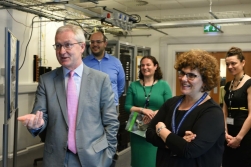
A world-class 5G technology test network will aim to put Britain at the forefront of the next wave of mobile technology - potentially adding up to £173 billion to the economy by 2030.

It may not be immediately apparent what volcanoes, artificial intelligence and the Arctic all have in common. Yet they are all subjects of ground-breaking University of Bristol research which was celebrated this week at an event to commemorate 10 years of the European Research Council.

The University of Bristol has announced plans to establish the world’s first open access Quantum Technologies Innovation Centre, focusing on taking quantum research from the lab and into the commercial world and positioning the UK as a global leader in the field.

Dr Oliver Payton, Senior Research Associate in the Department of Engineering Mathematics, is taking part in Voice of the Future 2017, a science policy event, at the Houses of Parliament today [15 March].

The University of Bristol is ninth in the UK and one of 12 UK institutions in the top 100 universities worldwide, according to the latest Times Higher Education (THE) World University Rankings.
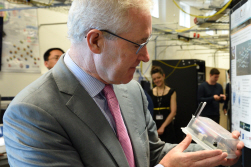
Three sites in the UK will be linked up via 5G test beds for the first time thanks to £16m investment from the Government. The funding, announced by Minister for Digital Matt Hancock today, will bring three leading universities together for the development of the world's first trials of end-to-end 5G system.

The University of Bristol has been ranked 19th in the Times and Sunday Times Good University Guide 2017 - a rise of one place on last year.

The latest cutting-edge research will be on display at Big Bang Bristol, a free two-day science, technology, engineering and maths (STEM) extravaganza at the Trinity Arts Centre, Bristol, on Thursday 6 and Friday 7 July.

The NHS is frequently in the news about its ongoing funding crisis. New research suggests demand for health services is set to continue to grow faster than GDP per head in all developed countries around the world. Along with a paper about the J-value model for life-expectancy growth in industrialised countries, the research establishes a reason why people in the UK will want to spend an increasing fraction of their income on health services.

Do spiders use their web as a computer? New research, led by the Universities of Bristol and Oxford, will look at spiders’ webs to investigate their computational capabilities and based on this research they will develop new sensor technology to measure vibrations and flow.