
The best of both worlds: a fundamental AI PhD in collaboration with Allianz UK
A PhD in COMPASS, the EPSRC Centre for Doctoral Training (CDT) in Computational Statistics and Data Science, in collaboration with Allianz Insurance, gave a student valuable hands-on industrial experience, which has enabled his career direction.

Image: Ed Davis
One of the UK’s largest insurers, Allianz established a partnership with the University of Bristol in 2019, with the aim of sharing knowledge, skills, and opportunities in data science and machine learning. Initially, the relationship focused on collaboration with researchers from the Faculty of Social Sciences and Law, and the company was delighted to have a well-defined opportunity to engage with mathematicians through the creation of COMPASS.
AI is much more than just chatbots. Building on fundamental AI research at Bristol by Professor Patrick Rubin-Delanchy (now Edinburgh) for representing networks theoretically, Bristol statistician, Professor Daniel Lawson, saw the opportunity to develop these ideas into meaningful impact, through proposing a joint PhD project with Allianz. When Ed Davis joined COMPASS as a PhD student in 2020, he was presented with a wide selection of projects.
‘I chose the project with Allianz, as the topic looked a really interesting field of maths to study for four years, and I wanted to gain experience of working with industry. At the time, I didn’t know if I wanted to continue in academia or work in industry, and this project offered the best of both worlds.’ Dr Ed Davis.
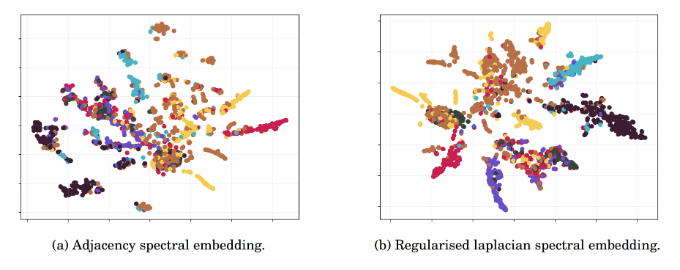
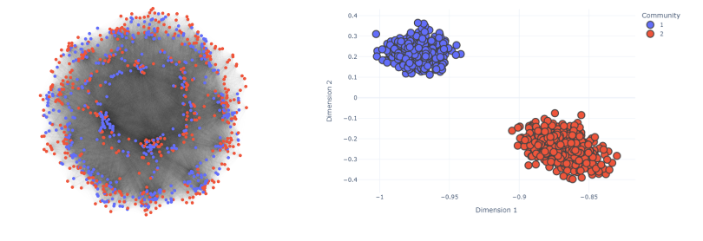
Chatbots are AI trained on sequences of words, but we can also use other types of data. Networks are a mathematical concept to represent connections, and can be applied to many real-world scenarios including flights, neurons in the brain, and genetics. Dynamic Graph Neural Networks are artificial intelligence models designed to analyse connections that change over time. The Bristol team developed a suite of robust methods, including dynamic graph embedding, to quantify the uncertainty of Dynamics Graph Neural Networks.
Of particular interest to Allianz was how these general methods could be used to construct a rich picture of changes in connection between features of their customers - such as income, default rate, choice of car - might make their decision support models obsolete.
During the project, the University of Bristol team and Allianz typically met once a month for Ed to give an update on the theoretical developments. He also had the opportunity to give longer-form talks to Allianz’s wider “Innovation Forum” research group of 30 people. Ed helped Allianz to develop an internal data visualisation tool to determine which customers should be offered various financial products when their performance has changed.
‘The aim of the collaboration was to be able to apply dynamic graph embedding techniques developed by the University of Bristol in a real-world business setting. This was very much a two-way collaboration as Ed helped us to translate his research, and we guided him as to how his theory could be applied, and discussed challenges that it faced against real-world datasets.
The collaboration allowed members of the team to get hands-on experience and a deeper understanding in an area of statistics where we previously had no knowledge. This extended to the team at a wider level as Ed often gave talks about the work he was currently doing. Keeping up to date with the current research happening in the data science space is really important as it allows us to keep improving as a team and deliver the best outcomes for our customers.
The real success for us was the creation of an internal package that applies the findings from Ed’s research in a way that it can be applied to our data in a meaningful way. While increasing the statistical knowledge of the team is a bonus, this translation of his work into a tangible output ensures that the knowledge remains in the team and can deliver benefits. This would not have happened without the collaboration between Allianz and the University of Bristol.’ Dr Lorna Sumption, Lead Data Scientist, Allianz UK Personal Lines Data Science.
Ed graduated from his PhD in summer 2025, and started work as an Applied Scientist with Amazon Artificial General Intelligence (AGI) in Autumn 2025. As part of Amazon’s Research team based in Cambridge, he is now working on a large-scale generative text-to-speech project.
‘During my PhD, I published 2 peer-reviewed papers in top-tier machine learning conferences (International Conference on Learning Representations ICLR 2025, Uncertainty in Artificial Intelligence UAI 2025) on graph neural networks, conformal prediction, and network bootstrapping, with an additional preprint on multi-graph embeddings. The methods we developed are much more robust due to the connection with Allianz. From a personal development point of view, regularly presenting my work to Allianz employees gave me excellent experience in communicating my results to different audiences. The combination of technical and transferable skills I gained were invaluable in helping me secure the job with Amazon after my PhD.’ Dr Ed Davis.
Additional benefits of the collaboration
As part of the wider relationship with the University of Bristol, Allianz also proposed challenges for two “Datathons”. PhD student teams from COMPASS CDT and the Interactive AI CDT worked intensively in small teams to devise the best predictive model for the size of insurance claims (2020 Datathon) and to forecast pollution levels in Madrid city centre (2021 Datathon). These workshops gave students valuable experience of industrial engagement outside of their PhD focus, and Allianz different perspectives on their challenges within a rapid timeframe.
Senior data scientists from Allianz also generously shared their experience with COMPASS PhD students by giving a guest lecture “The realities of data science no one talks about”, and participating in COMPASS’s ‘Careers in Data Science’: Data Science@Work Seminar series.
‘Allianz has long maintained a close collaboration with the University of Bristol and its School of Mathematics. We have hosted a second-year student for a placement year, which provides valuable practical experience for both sides. We have also taken part in the “Maths at Work” event several times, which is a great opportunity to connect industry and students. Collaborating with the university and engaging directly with students has been a very effective recruitment channel for us.’ Dr Dandan Shi, Head of Academic Partnership and Research (Data Science) at Allianz UK Personal Lines.
Story written by Dr Joanna Jordan