
16 December 2025
Bristol students build HPC cluster and secure second place at CIUK 2025
Revamped 'Student Cluster Challenge' delivers hand-on advanced computing experience, industry connections and future career opportunities.
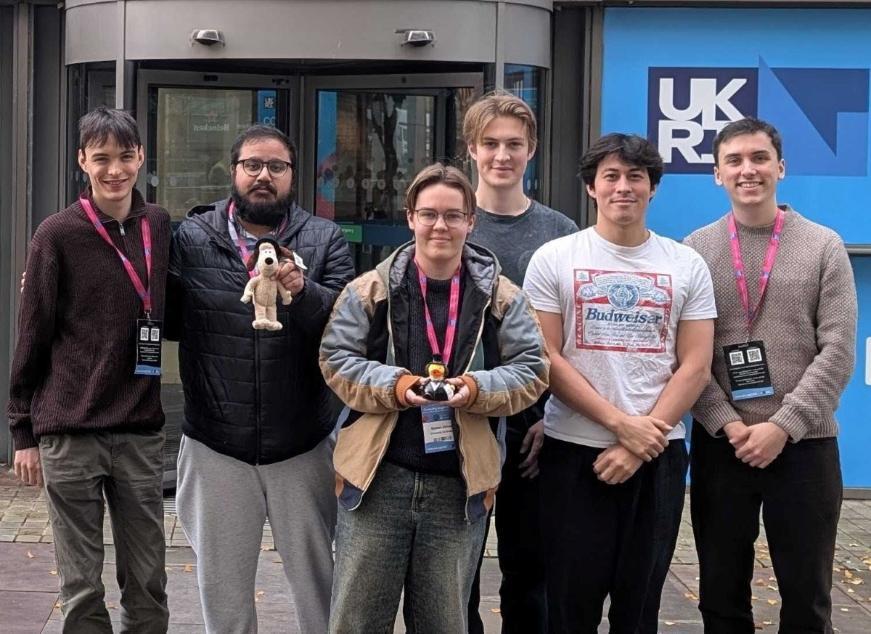
Team Isambards from left to right: Asher Bloom, Mobeen Mohammed, Rowan Johns, Kyrian Salas, Thomas Bale and team lead Joseph Moore.
CIUK Cluster Challenge returns to Manchester
The popular CIUK Cluster Challenge returned to Manchester this year with eight student teams attending the UK’s largest HPC conference to take on real-life HPC challenges and network with industry professionals and fellow students from other universities.
With the competition growing in popularity, teams first had to qualify for the final in-person challenges over a three-week period in October.
Team Isambards impress at the finals
Team Isambards from the University of Bristol qualified for the finals and impressed by securing second place overall, both in the final and in the qualifying rounds, despite some team members being completely new to high-performance computing.
But as Joseph Moore, team lead and PhD researcher at Bristol, emphasised:
“The student cluster challenge is not about rankings. It’s about inspiring the next generation of high-performance computing (HPC) professionals, giving students challenges they can’t get in a classroom and nurturing their future career opportunities.”
Hands-on industry challenges
The CIUK Student Cluster finals featured two hands-on challenges from industry partners Alces Flight and OCF, which the University of Bristol team members Vladimir Dementyev, Thomas Bale, Rowan Johns, Mobeen Mohammed, Kyrian Salas and Asher Bloom had to solve in just three hours per challenge.
In the Alces Flight challenge, students were given physical servers and tasked with building and provisioning their own HPC cluster from scratch. They installed and configured the hardware, ran machine learning and molecular dynamics workloads and even pitched their HPC setup as a service with user documentation and advertising.
The OCF challenge focused on HPC security, requiring teams to set up system monitoring and alerts triggered by suspicious activity on their systems.
Networking opportunities and career pathways
A treasure hunt with vendors added a new networking dimension to the competition and encouraged students to engage with companies and explore internship opportunities.
These real-world skills and connections have led to previous participants going on to secure opportunities such as a graduate role at StackHPC, a PhD studentship at the UK Atomic Energy Authority and positions in financial services that require HPC expertise.
“This year was probably the strongest in terms of student experience,” Moore reflected. “It’s about building interest and opportunities for the future. The event introduces students to advanced HPC tools, industry practices and professional networks. It also helps guide them on what comes after their degree and opens many new opportunities for students.”
A unique student experience
Speaking about his experience of taking part, University of Bristol student, Tom Bale said:
"I really enjoyed both the competition and the conference. CIUK allowed us to talk to exhibitors and connect with other like minded students which was a pretty unique experience. I far exceeded my own expectations, especially with the Alces Flight challenge and the servers. We set up a small server with an easy to use HPC management tool, then ran various jobs and benchmarks on multiple virtual nodes. In the second challenge, we set up an alert system for a HPC using various visualisation tools and Slack integrations."
Fellow Computer Science student, Kyrian Salas, added:
"The competition was really fun. It was great meeting the other teams, and the challenges like Alces Flight's server set up were awesome. I learnt the most from the preparation and qualifiers when I learnt about Slurm and a lot of the other fundamentals of HPC."