SmartDairy Project Information
SmartDairy assesses challenges, explores innovations, and creates new solutions to achieve a climate-smart dairy system.
Food systems are responsible for one third of global greenhouse gas (GHG) emissions. Dairy production is a significant contributor to those emissions and, given that global demand for dairy is projected to increase, there is an urgent need to reduce emissions from this sector. For example, a clearer understanding of the functioning and acceptability of climate-smart innovations that can be implemented along the dairy supply chain can contribute to achieving a climate-neutral EU continent by 2050.
Using a multi-actor, multi-disciplinary approach across four European countries, the SmartDairy team explores interconnections and consequences of climate-smart innovations within the dairy system.
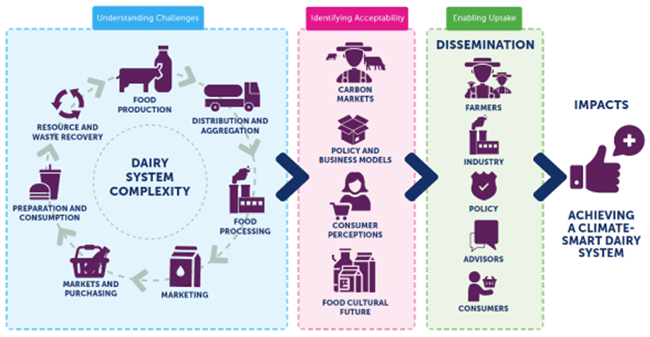
We use living labs and stakeholder workshops to co-design innovations that will subsequently be evaluated with dairy system stakeholders across the four countries. In each country, we have a specific focus, as explained below.
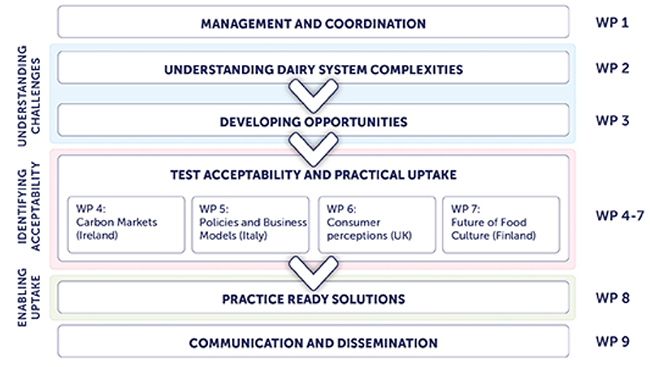
In Ireland we assess the acceptability of dairy system carbon markets to accelerate the uptake of carbon mitigation measures by farmers. In living labs, together with dairy farmers and other stakeholders, we test the acceptability and functioning of voluntary carbon markets in a real-life setting. Heavily influenced by the stakeholder co-designed carbon market, dairy farmers and citizens will then buy and sell carbon credits in an experimental auction. For example, dairy farmers can sell carbon credits for a commitment to implement climate-smart innovations to citizens interested in supporting climate-smart dairy production. Implemented innovations are farm specific and can include measures such as reduced fertilizer use, better breeding, improved slurry management, planting trees, etc.
In Italy, we combine a qualitative and quantitative approach to assess socio-economic and environmental impacts of new policies and business models on climate-smart upgrading of the dairy supply chain. Business models include closed-loop systems that are responsible for a product throughout its lifecycle with a focus on reducing waste and increasing resource efficiency. Policy options include a carbon tax and incentives to encourage carbon sequestration. The qualitative approach is based on a participatory exercise that is informed by a quantitative analysis based on an optimisation model that simulates the impact of various policies and business models.
In the UK, we considered consumer perceptions towards a climate-smart dairy system. We used a multi-stakeholder approach which included farmers, dairy processors, distributors and retailers, consultants, and consumers. We combined focus group interviews with farmer surveys and consumer experiments. The latter included a choice experiment to elicit the perceptions and willingness to pay among consumers for various hypothetical dairy products that differ regarding carbon emissions. We also conducted a field experiment during University open days where we offered the consumer an opportunity to purchase yoghurt from the researchers with varying climate credentials. Our research shed light on how consumers value climate-smart innovations in the dairy sector, how information affects these valuations, and how farmers perceive their current economic environment and what kind of government actions could aid adoption.
In Finland, we consider the future of food culture and conduct qualitative interviews with consumers representing different socio-economic backgrounds. We analyse how consumers see the role of dairy and alternative products in their daily food practices, how they think the products should be improved in terms of sustainability and carbon-smartness, how they see the futures of these products, and how they could adapt behaviour to reduce dairy-based food waste.
Country specific outcomes will be consolidated during the final stage of the project. Here, we plan to present findings from all countries to local stakeholders for creation of solutions that enable a climate-smart dairy system that is acceptable to all actors from farm to fork. An overview of the project structure and the work packages (WPs) is provided in the figure below.
Overall, SmartDairy will create impact by reducing GHG emissions, increasing resource efficiency, and reducing waste, bringing us a step closer to a climate-neutral future.