Goal 14: Life below water
Conserve and sustainably use the oceans, seas and marine resources for sustainable development
Our research
Climate change is having a significant impact on freshwater fish populations, according to Bristol researchers. In a paper published in December 2024, a team from the School of Biological Sciences showed that freshwater fish that live nearer to the earth’s poles are outperforming their counterparts that live near the equator as the equatorial regions become too warm and polar regions heat up. Understanding these changing patterns of fish population distribution will help contribute to conservation efforts and improve sustainable marine management.
Two projects to help improve UK flood resilience will be drawing on expertise from the University of Bristol in 2024. The first is being co-led by University researchers, and is focused on improving flood adaptation measures through better computer modelling, cutting the time and cost of projecting flooding for the rest of the century. The second is a national Floods & Drought Research Infrastructure project, led by NERC and the UK Centre for Ecology & Hydrology, and supported by experts from the University of Bristol and other partners. This project is looking at ways to stem the impact of extreme weather on communities and infrastructure.
Our students
In May 2024, the University hosted the annual British Hydrological Society’s Peter Wolf Symposium for 2024. The two-day conference provided an opportunity for PhD students and early career researchers to present their work to academic colleagues and industry experts. The theme for the event was digital futures for observational and predictive hydrology, with speakers and presenters addressing topics across hydrology, hydrogeology, and water resource management.
A study by a Bristol PhD student into the impact of climate change on marine plankton was published in the prestigious journal Nature in November 2024. The paper, co-authored with partners from Liverpool, Germany and Sweden, showed that plankton are at high risk from ocean temperature rises, which imperils a wide range of other marine life for which plankton is a major food source.
Our communities
A unique collaboration between a Bristol researcher and a musician has produced an unusual research output in the form of an album of recordings from underwater. Released in October 2023, the collaboration is based on research by Bristol academic Dr Jack Greenhalgh, an acoustic ecologist, and shares the rhythms and soundscapes of pond life alongside detailed descriptions, scientific illustrations, and high-resolution microscope images.
Four Bristol researchers were among presenters at the annual symposium of the International Society for Fish Biology in Bilbao in July 2024. They led a session for academics, practitioners, and industry leaders sharing their findings on fish population distribution in special areas of conservation in Cardigan Bay, off the Welsh coast, and how their methods might aid conservation and marine management efforts.
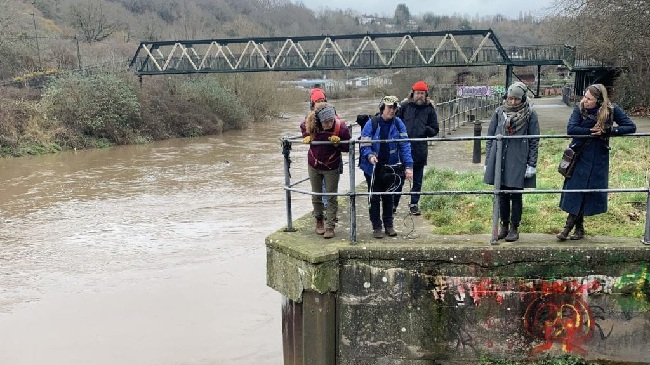
Funded by the University’s Brigstow Institute, the Water Futures project is an exploration of the sociodigital spaces of rivers and their communities. Running in 2023/24, the project sought to use art, performance, conversation and other co-designed, qualitative methods to explore the interaction of rivers and the communities that coexist with them. In February 2024, a group of researchers, partners and community members gathered for a workshop which took place on the riverbank, using creative practice such as audio recording and music to explore and discuss the river in new ways.
Ourselves
The University and partners from the GW4 region received a combined £36m funding in late 2024 to renew two doctoral training partnerships on biology and environmental change. The South West Biosciences Doctoral Landscape Partnership, funded by the BBSRC, is delivered with partners including the Marine Biological Association, and aims to inspire and train future leaders in biosciences. The GW4+ Doctoral Landscape Training Partnership, funded by NERC, links regional universities with partners including the British Antarctic Survey, the UK Centre for Ecology and Hydrology, and Plymouth Marine Laboratory, and trains students in the interdisciplinary field of environmental science. We are also part of a consortium, led by the University of Southampton, in a new Centre for Doctoral Training for flood research, aimed at protecting against rising river, rainfall and sea levels.
The University’s Days to Make a Difference initiative offers all staff a paid day’s leave to volunteer for a charity, organisation or other good cause. October 2023 saw the University’s Research and Enterprise Partnerships Team volunteering down at a farm in Winford, where they planted trees to help reduce the risk of flooding. The day was organised with our friends at the Bristol Avon Rivers Trust (BART), who work on improving land management, restoring rivers, and reducing water pollution in the Bristol Avon region. As well as a great opportunity for team building, the day gave staff a valuable insight into river ecosystems, and a chance to make a real difference to local waterways.