
Designing Magic
Audio transcript:
WSI were collectors of ideas, drawing from mythology, literature, folk traditions, and wherever curiosity led them. Some productions grew from years of accumulated research; others came together more quickly; built on themes and images the company had long been turning over. In 1982, WSI were invited by the British Council to perform at the First International Theatre Festival in Toga Village, Japan. It was during researching for this trip that John Fox discovered a Japanese folk legend about a wagtail , and that story eventually became the heart of The Wasteland and the Wagtail performance, woven together with the plot of Shakespeare’s King Lear to create something genuinely new: touching on themes of authoritarian power, cataclysmic war and symbolic rebirth. That’s how WSI worked: gathering threads from very different places and finding the unexpected story that connected them. The development process was physical too, not just intellectual. Every production left behind a rich trail of sketchbooks, storyboards, draft poems, and fragments of text showing how ideas shifted and evolved. Songs were written and rewritten. Images were tested, scrapped, and started again.
The Wasteland and the Wagtail (1982)
The Wasteland and The Wagtail was one WSI’s many international performances. In 1982, WSI was invited by the British Council to perform in the First International Theatre Festival in Toga Village, Japan, which included Japanese, American, Polish, Indian and British theatre groups. It involved an extensive research process into Japanese culture and traditions, and a team of twelve had only fourteen days to produce the three-hour show over three concurrent evenings.
Taking place on a mountain next to a commercial ski run, The Wasteland and The Wagtail led an audience of 300 people on a pilgrimage through a modern version of Shakespeare’s King Lear blended with an indigenous Japanese creation story about a wagtail. The performance drew parallels between Japan and Britain in a process of cultural exchange and spontaneous international community, touching on themes of authoritarian power, cataclysmic war and symbolic rebirth.
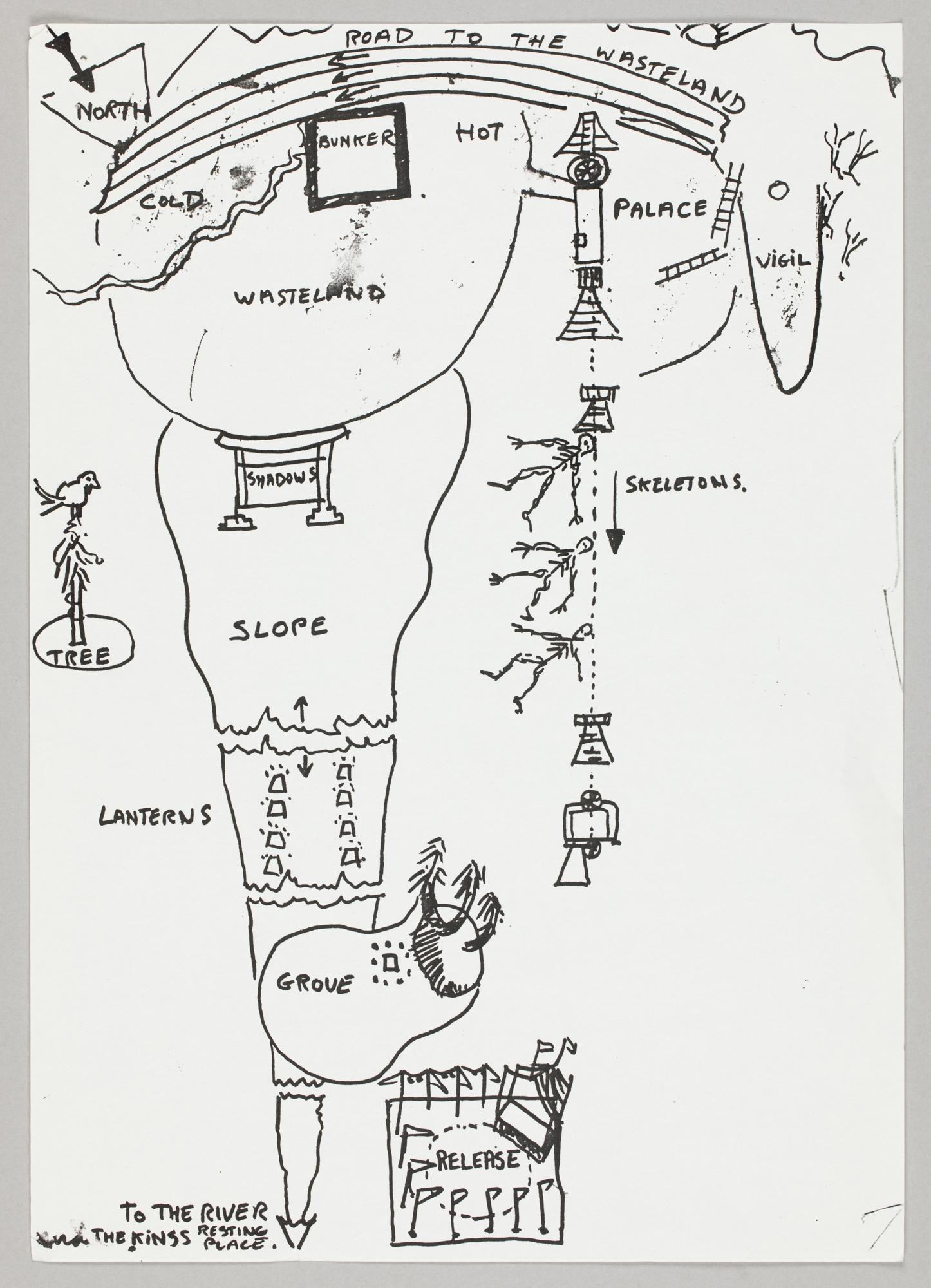
Production site plan
This plan shows suggested locations on a mountain for various sets within The Wasteland and The Wagtail production. Although they later modified their site plan to exclude the top third of the mountain, many of these initial ideas featured in the final performance, including the skeleton puppets, which they ferried past the audience using out-of-season ski lifts. This site map demonstrates WSI’s approach to performance, which blends the local environment into their stories.
‘The Poem of Turning Autumn’ and ‘Poem of Transition’ audio narration, John Fox, 1982, trans. Eve Sakrai-James, 2026.
‘The Poem of Turning Autumn’ began as rough draft called ‘The Transition Poem’ written by John Fox. This poem along with another called ‘the Wagtail Poem’ were performed in English at the Toga Festival and translated for the Japanese audience in the performance programme. The audio you can listen to here is a 2026 English translation of these poems by Eve Sakrai-James. They have been narrated to capture a sense of their original performance.