The QUADAS-3 tool was published in Annals of Internal Medicine in February 2026. It should be cited as follows:
Whiting PF, Tomlinson E, Rutjes AWS, et al. QUADAS-3: A revised tool for the quality assessment of diagnostic test accuracy studies. Ann Intern Med. 17 February 2026. [Epub ahead of print]. doi:10.7326/ANNALS-25-02104
QUADAS-3 structure
The QUADAS-3 tool comprises 6 phases:
|
Phase 1: State the systematic review synthesis questions |
Once per review |
|
Phase 2: Define the ideal test accuracy trial for each synthesis question |
Once per review |
|
Phase 3: Draw a flow diagram |
Once per study |
|
Phase 4: Identify the accuracy estimates to assess for risk of bias and applicability |
Once per study |
|
Phase 5: Assess risk of bias and concerns regarding applicability |
For each selected estimate |
|
Phase 6: Overall judgment |
For each selected estimate |
Explanation and Elaboration
Detailed guidance on applying the tool is found in the Explanation and Elaboration document published in Annals of Internal Medicine. This should be cited as follows:
Davenport CF, Rutjes AWS, Mallett S, et al. QUADAS-3 explanation and elaboration: guidance for quality assessment of diagnostic test accuracy studies. Ann Intern Med. 2026;179:e2504943. doi:10.7326/ANNALS-25-04943
Overview of Phase 5: Assess risk of bias and concerns regarding applicability
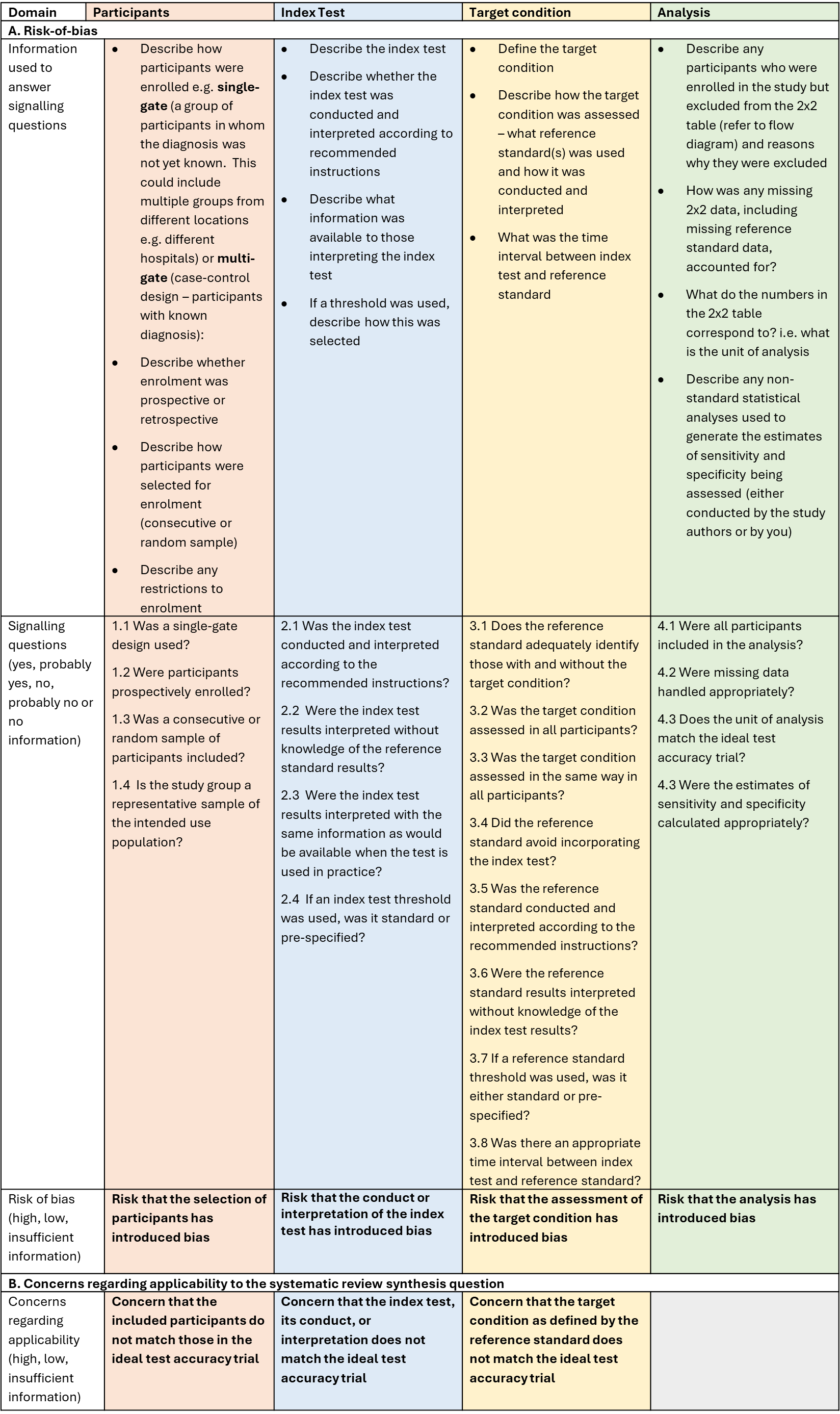
Risk of bias is assessed across 4 domains: Participants, Index test, Target condition, and Analysis. The first 3 domains are also assessed in terms of concerns regarding applicability to the synthesis question. Signaling questions are included to help judge risk of bias. The Table below provides a summary of the full Phase 5 components of the tool.