
The Experience and Impact of Government Social Researchers
This research examines the current experiences of Government Social Researchers to understand how the future might look and what a stronger, more resilient social research function in government could be. It starts from the view that GSR work is essential for effective policy and operational decisions but often carried out under significant organisational and political constraints.
About the research
In 2024-25 the team carried out 43 semi-structured interviews and focus groups with GSR members in 19 departments and non-departmental public bodies, submitted Freedom of Information requests on the GSR workforce and Civil Service People Survey, and collated documents about the profession.
Interviews focused on five areas: evidence generation; work planning and organisational change; relations with “customers” for analytical products, including accountability and trust; inter-professional relations with policy, operational and other analytical professionals; and GSR professional identity.
Our study asks how far GSR, now embedded across government, can exercise impact, visibility and authority as Government Social Researchers negotiate the “machinery of government” with policy and analytical colleagues.
The Government Social Research Profession
Government Social Research (GSR) is an analytical profession working across UK government. It sits at the research-policy nexus, generating new evidence and bringing a people-centred perspective into policymaking and operations alongside policy teams and other analytical professions.
In January 2025 there were 2,650 GSR members spread across more than thirty departments, non-departmental public bodies and devolved administrations. This embedded presence makes social research a core function in how evidence is generated, interpreted and used in government decisions.
Interviewees described working in politicised environments where evidence can be contested, sidelined or selectively used, and where “shoddy” research can give ministers confidence that evidence is robust when it is not.
Social research in government has a long history, but today’s professionalised GSR cadre faces a future shaped by the growth of other analytical professions and emerging tools such as artificial intelligence that may transform how evidence is produced and used.
Research findings
The Values of Social Research
Within the Civil Service, the value of social research lies less in headline “impact events” and more in how it shapes understanding of social problems. GSR members told us that their work adds a people-centred perspective to government, helping officials to see how policies are experienced in everyday life. Rather than simply proving whether something “works”, social research was described as enabling government to understand how, why, for whom and under what conditions policies work, and to adjust design and implementation accordingly.
GSR members emphasised the everyday and relational nature of this work. They are proactive in spotting where evidence is needed, sometimes before a formal commission is made. Interviewees described advising on appropriate methods, assessing the quality of existing evidence and horizon-scanning to anticipate emerging issues. A core part of the role is providing expert advice to policy and operational colleagues: translating loosely framed worries into feasible research questions and supporting teams to interpret findings in relation to.
Status, Progression and the Gendered Authority Gap
Most GSR members hold substantive grades at Research Officer (Higher Executive Officer) or Senior Research Officer (Senior Executive Officer) – 24% and 33% respectively. A further 29% are Principal Research Officers (Grade 7) and 7% Senior Principal Research Officers (Grade 6). GSR members described this as a “very thick band” at SEO/G7 level, with Principal Research Officer often experienced as the ceiling of the profession and it being “very difficult to go up beyond grade 7”. These patterns contribute to a perception of poorly defined pathways into senior leadership roles.
Themes of gender and the status of analytical professions were closely linked in several interviews. Across accounts, GSR was widely perceived as lower in the ‘pecking order’ than the Government Economic Service (GES) and the Government Statistical Service. Interviewees described a “gendered authority gap”, noting that GSR tended to be female while the GES tended towards being male, and that senior policy roles were also more likely to be held by men. This perceived gendering was said to contribute to a “de facto exclusion” of social research from policy conversations and organisational influence. GSR members felt they were treated as less intelligent and less specialised than economists and statisticians, and as working with “soft data” or “common sense” rather than technically robust methods.
GSR and GES members by gender (2025)
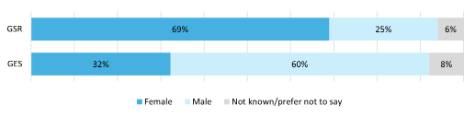
Several interviewees observed that when policy officials “think analyst, quite often what they’re thinking is an economist”. Ministers were said to “just want numbers”, with briefings prioritising “short, sharp numbers” over qualitative or theory-based insights. Economists were perceived to present models with confidence, while social researchers were more cautious about limitations and uncertainty. These dynamics shape who is invited into key decision-making spaces and whose evidence is treated as indispensable.
Policy implications
Our research suggests that, if the new 2025-29 GSR strategy is to deliver on its stated aims, it needs a sharper focus on leadership with the authority and resourcing to drive change. The policy implications of our research cluster around three themes – Engaged Interprofessional Working, Enabled Systems Leadership and Embedded Cultures of Learning – which together would help deliver the big prize: a government better able to design and deliver policies with a holistic understand of social life and people’s experiences.
Engaged Interprofessional Working
- GESR leadership, the Chief Social Researcher and Departmental Head of Profession (HOP) should jointly own and codify a single, integrated analytical model, setting out how social research and other analytical professions are expected to work together on shared priorities, and embedding this in departmental strategies and profession plans. HM Treasury and the Evaluation Task Force should develop and issue cross-government guidance with worked examples on structuring, commissioning and resourcing cross[1]disciplinary analytical teams, and Departments should be required to build cross[1]profession analytical input into governance, business cases and commissioning as standard practice. Departmental learning and development budgets should be used to fund joint leadership programmes, policy–analysis masterclasses and shared learning events, with clear participation expectations across analytical and policy professions.
Enabled Systems Leadership
- Senior GSR governance should be reconfigured so the Chief Social Researcher, Deputies and HoPs have explicit, resourced system-leadership roles and objectives, including responsibility for identifying cross-cutting issues, agreeing common standards and reporting on progress across departments. HoPs should be positioned at Senior Civil Service level with clearly differentiated roles and each department maintaining a published GSR and analytical strategy, while senior GSR leadership is funded and mandated to set methodological standards, support innovation (including exploratory work on AI) and strengthen regional analytical hubs. GESR leadership, the Chief Social Researcher and Departmental HoPs should treat equality – including closing gendered authority gaps – as a core dimension of systems leadership, and dual career pathways should give equal status to technical specialists and generalist leaders.
Embedded Cultures of Learning
- GESR leadership should define and communicate a clear vision for evidence and learning cultures across government, integrating it into profession strategies and performance expectations, and explicitly treating consultancy, influencing and communication skills as core capabilities for social researchers. Policy officials’ practical skills in commissioning, interpreting and using research should be strengthened through structured learning offers; evaluation and theory of change should be embedded from the start of policy design, with the Evaluation Task Force leading on robust, methodologically diverse standards; a “publish by default” regime for research should be implemented and monitored; and every GSR member should have a live, resourced development plan, backed by protected time, ring-fenced budgets and structured partnerships with academic and commercial research organisations.
Taken together, these actions would mean the new GSR strategy rests on leadership with real power, not just aspiration, and would move GSR towards a more integrated, visible and authoritative role at the heart of evidence-informed government – helping ministers and officials engage with social realities earlier and more clearly when making decisions that shape people’s lives.
“I don’t want to say there’s a stigma attached to being in GSR, but it does feel like that a little bit sometimes in terms of… they don’t think you’re… I’m going to say, as clever, which is quite annoying considering when the opportunities I’ve had to do other people’s work. I’m like, this is actually quite simple. I don’t think you could do my job. But there’s a definite thing [with] people thinking that they could do GSR very easily and not the other way around”.
Further information
Government Research and the ‘Social’ Profession (GRASP) with a final report titled “The Future for the Profession: The Experience and Impact of Government Social Researchers”. https://doi.org/10.59019/QODW8846
Image credit: Photo by Patrick Perkins on Unsplash
The researchers
Dr Julian Molina, Senior Lecturer in Public Policy, University of Bristol
Professor John Connolly, Professor and Vice Dean, Glasgow School of Business and Society, Glasgow Caledonian University