
Call for global monitoring of infectious diseases in dogs and cats
A new study led by the University of Bristol's School of Veterinary Sciences recommends a global system is needed to monitor infectious diseases of companion dogs and cats.

A new study led by the University of Bristol's School of Veterinary Sciences recommends a global system is needed to monitor infectious diseases of companion dogs and cats.

Researchers have identified four new genetic regions that influence birth weight, providing further evidence that genes as well as maternal nutrition are important for growth in the womb. Three of the regions are also linked to adult metabolism, helping to explain why smaller babies have higher rates of chronic diseases later in life.

Scientists studying the genes and proteins of human cells infected with a common cold virus have identified a new gene identification technique that could increase the genetic information we hold on animals by around 70 to 80 per cent. The findings, published in Nature Methods, could revolutionise our understanding of animal genetics and disease, and improve our knowledge of dangerous viruses such as SARS that jump the species barrier from animals to humans.

New research by scientists from the University of Bristol have found that men and women see things differently.

Academics from Bristol were in Hangzhou, Eastern China, last week to attend the Worldwide Universities Network (WUN) Ideas and Universities Conference 2012, jointly organized by the WUN and Zhejiang University in Hangzhou.

An international team of scientists has come up with a new way to treat carbon dioxide (CO2) so that it can be used in efficient and environmentally friendly methods for extracting oil.

Like gangsters running a protection racket, drongos in the Kalahari Desert act as lookouts for other birds in order to steal a cut of their food catch. The behaviour, revealed in research led by Andy Radford and Linda Hollén from the University of Bristol, may represent a rare example of two species evolving from a parasitic to a mutualistic relationship.

An international team of scientists has developed a new technique to aid crops at risk from a devastating agricultural parasite commonly known as the ‘honey fungus’, one of the most serious diseases of trees and shrubs across the northern hemisphere. The development allows crops to be screened for natural resistance by adding DNA with fluorescent genes to the fungus before being planted out.

The elitist nature of European politics leads to a damaging inability of those in power to communicate with the public, while media representations only serve to reinforce the distance between Europe’s citizens and the governing elites, according to a new book by a University of Bristol political sociologist.
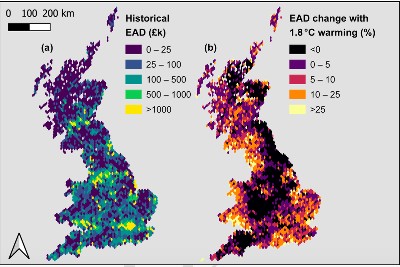
Annual damage caused by flooding in the UK could increase by more than a fifth over the next century due to climate change unless all international pledges to reduce carbon emissions are met, according to new research.