
Celebrating a decade of collaboration between EDF and the School of Mathematics
The School of Mathematics’ longstanding relationship with the Research and Development (R&D) department of Électricité de France (EDF), is a prime example of a longstanding mutually beneficial academic-industrial partnership.
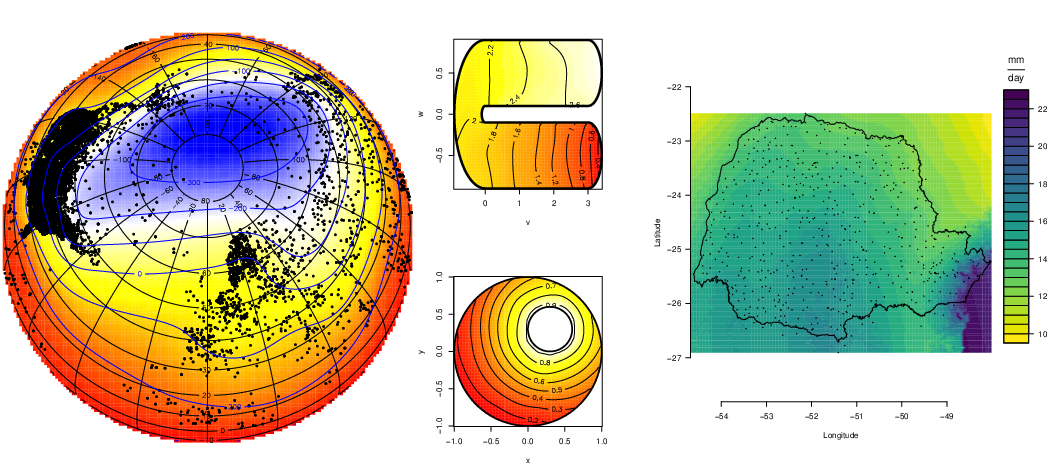
Figure 1: Example applications of the additive quantile regression models of Fasiolo et al. (2020) developed during the partnership. Left: model for minimum daily temperatures on the globe. The Gulf Stream is visible. Centre: finite-area spatial components, based on soap film smoothers. Right: quantile predictions of weekly rainfall in the Paraná state of Brazil.
EDF is one of the world’s largest electricity producers, and the world’s leading producer of low-carbon energy. Accurate forecasts of electricity demand are important for making informed decisions, increasing efficiency, improving reliability, and incorporating renewable sources of energy. A type of statistical model that allows for flexibility in the relationship between explanatory (cause) and outcome (effect) variables – known as “Generalised Additive Models” (GAMs) – are particularly useful in electricity load forecasting, and are a research strength at the University of Bristol.
Dr Matteo Fasiolo, currently Senior Lecturer in Statistical Science in the School of Mathematics, began working alongside Professor Simon Wood and researchers from EDF when he joined the University of Bristol as a Research Associate back in 2015. When Simon moved to the University of Edinburgh in 2020, Matteo was the natural choice to lead the third renewal of the partnership, and all subsequent work, between the University of Bristol and EDF.
Focusing on developing new statistical methods which combine GAMs with quantile regression, the collaboration between EDF and the School of Mathematics has been particularly fruitful. It has resulted in multiple co-authored journal publications in high-impact journals such as the Journal of the American Statistical Association, open source R packages implementing the methods, and a textbook on electricity load forecasting models. The R packages have been implemented by EDF R&D to forecast electricity demand and prices.
Dr Yannig Goude, Senior Researcher in Statistics and Machine Learning at EDF Lab and Associate Professor at the Laboratoire de Mathématiques d’Orsay, Université Paris-Saclay, has been involved in the partnership since the start.
‘As a major electricity and gas provider, EDF faces many statistical and machine learning problems, particularly in the field of demand modelling and forecasting. Partnerships with academia are of course a fundamental component in solving these problems and we have a long and constructive history of collaboration with Simon Wood and Matteo Fasiolo, on statistical modelling and its application to EDF data.
Together, we have developed not only the proper methodologies to solve our industrial problems but also have implemented these methods in open source software (R packages mgcv and satellite packages such as qgam, mgcViz).
Since 2014, this work has produced significant improvements in the models used for EDF operational forecagoosts on electricity markets. As these markets are evolving constantly, we look forward to continuing to collaborate with the University of Bristol and develop new models to face the growing complexity of electricity consumption and production.’
- Dr Yannig Goude, Senior Researcher in Statistics and Machine Learning at EDF Lab and Associate Professor at the Laboratoire de Mathématiques d’Orsay, Université Paris-Saclay.
The quantile regression and accompanying visualisation methods developed by Matteo, Yannig, and collaborators are sufficiently general that they have been used to study a wide range of other applications, from ecology to healthy ageing, in addition to energy forecasting.
EDF-sponsored PhD studentships
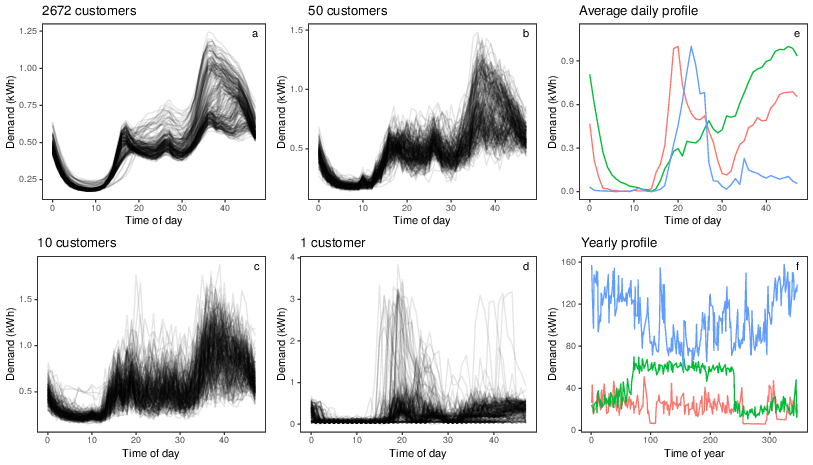 Figure 2: Plots a-d show the daily electricity demand profiles of the demand averaged over increasingly small groups of customers. Plots e and f show the average daily and yearly demand profiles of three customers. See Capezza et al. (2021) for more details.
The partnership has included co-funded PhD studentships through COMPASS, the EPSRC Centre for Doctoral Training (CDT) in Computational Statistics and Data Science, hosted by the University of Bristol’s School of Mathematics.
Working with Matteo, Yannig, and Christian Capezza (from the University of Napoli, Federico II), Euan Enticott worked on developing new methods to optimally combine different machine learning models to aid model inference and improve predictive accuracy. He used these methods to address challenges faced by the energy industry, including forecasting household energy demand, day-ahead electricity prices, and solar production, all of which are becoming increasingly important with the move towards decarbonisation. Straight after completing his PhD in 2025, Euan joined NESO, the National Energy System Operator.
‘Working with EDF throughout my PhD was invaluable for both my academic work and career development. Through collaborative projects I was able to apply my methods to interesting and real-world applications. Our approach allows the benefits of multiple machine learning models to be fully utilised and can help quickly adapt to industrial shocks such as Covid-19. In addition, the hands-on experience in the energy industry helped me to secure a position at NESO as a Senior Modeller upon finishing my PhD.’
- Dr Euan Enticott Senior Modelling Specialist, NESO.
In 2021, Ben Griffiths began working with Matteo and Yannig on his COMPASS PhD, focusing on combining quantile methods with techniques which handle big data, to make methods faster and more robust. He has applied these methods to projects involving solar production forecasting, wind production forecasting, and electricity demand for customers with electric vehicles, and will complete his PhD next year.
‘Working with EDF as my industrial sponsor has been very beneficial in a number of ways. It has provided opportunities to meet and collaborate with industrial researchers, who have suggested relevant problems with many interesting data sets which has ensured that my research can have a high impact.’
- Ben Griffiths, COMPASS PhD student, University of Bristol.
In addition, Aindrila Garai began her PhD, with Matteo and Yannig, on Energy Forecasting using Scalable Additive Models in 2024. Aindrila has been focusing on the development of new forecasting methods meant to adapt quickly to abrupt changes in electricity prices and demand dynamics, such as the energy crisis.
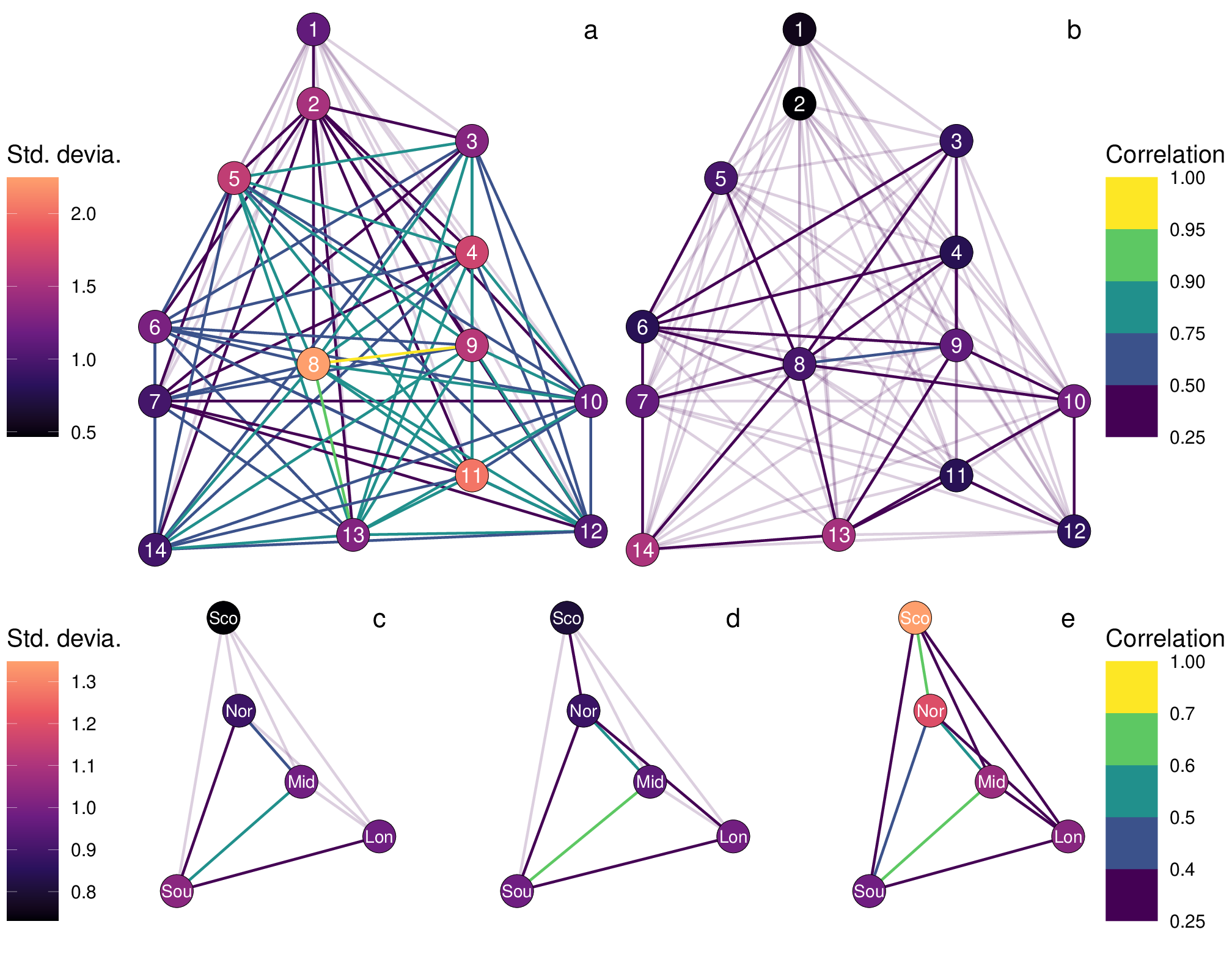 Figure 3: Variances (nodes) and correlations (edges) of electrical net-demand across the UK regions (a--b) or macro-regions (c to e), predicted by the model of Gioia et al. (2025). The plots correspond to 7am on 31/12/18 (a), midnight on 20/08/18 (b) and 10am on 14/06/18 (c to e, during storm Hector). Plot d is based on regional wind and precipitation forecasts, while c and e correspond to, respectively, a 25% decrease and increase of such forecasts.
Added value of the collaboration
The relationship between the School of Mathematics and EDF has also included opportunities for regular research visits, guest lectures, and training events. For example, in June 2023, an EDF team including Ikrame Bernabia, Manel Boumghar, David Obst, Thomas Kelaibi, Abdelhadi El Yazidi, Virgile Fritsch and Yannig delivered a well-attended Data Science@work seminar “Adaptive probabilistic forecasting of temporal data for electricity markets” at the University of Bristol. Accompanied by eight colleagues from EDF, the session included Yannig’s talk plus an opportunity for networking with PhD students from the School of Mathematics.
Matteo has given several hands-on training sessions on the methods he has developed on site at EDF. Some of these workshops were open to EDF and other companies, such as ENGIE and RTE (France’s Transmission System Operator) and attracted over 50 industrial participants. In 2023, Matteo’s workshop directly initiated a new collaboration with Sanaa Zannane, from EDF Energy, a subsidiary of EDF which supplies electricity and gas in the UK. Matteo and Sanaa subsequently secured EPSRC Impact Acceleration Account “Impact on Policy” funding for Ben Griffiths to pause his PhD project for 6 months, and use his new methods to analyse smart meter data from the FLASH trial, co-funded by EDF Energy and the Department for Energy Security and Net Zero. The focus of the project is to better understand how electric vehicle users engage with special tariffs, with the aim of reducing costs and carbon consumption.
‘Collaborating with researchers at EDF has been immensely stimulating. They bring deep sector expertise and challenging real-world problems that are invaluable both for generating ideas for new statistical and machine-learning methods and for rigorously assessing their effectiveness. It is particularly rewarding to see our methods deployed operationally at EDF in high-stakes settings, and I look forward to the next decade of collaboration.’
- Dr Matteo Fasiolo, Senior Lecturer, University of Bristol.
Story written by Dr Joanna Jordan
https://www.linkedin.com/in/joannafjordan/
- Fasiolo, M., Wood, S.N., Zaffran, M., Nedellec, R. and Goude, Y., 2021. Fast calibrated additive quantile regression. Journal of the American Statistical Association, 116(535), pp.1402-1412.
- Capezza, C., Palumbo, B., Goude, Y., Wood, S.N. and Fasiolo, M., 2021. Additive stacking for disaggregate electricity demand forecasting. The Annals of Applied Statistics, 15(2), pp.727-746.
- Gioia, V., Fasiolo, M., Browell, J. and Bellio, R., 2025. Additive covariance matrix models: modeling regional electricity net-demand in Great Britain. Journal of the American Statistical Association, 120(549), pp.107-119.