
Dr Moger Woolley
Honorary Fellowship 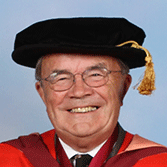
Wednesday 16 July 2014 at 11.15 am - Orator: Denis Burn
Madam Chancellor
An Honorary Fellowship is the highest honour the University of Bristol can bestow. The title is conferred on an individual who has attained distinction in their academic field or has contributed consistently and over a significant period of time to the life of the University. Over the past 100 years just 28 awards have been made.
Moger was born, brought up and educated in Somerset, but he really grew up when, aged 19, he joined the army and was posted to Cyprus at the start of the troubles in 1955. He left the army and came to Bristol University where he graduated in Physics in 1959.
Sport has played a large part in Moger’s life. He captained the university teams in cricket and hockey and excelled also at rugby, athletics and football. His sporting career had an early and lasting impact on his life: in his final year at university Moger played a hard-fought cricket match on a Sunday against a side captained by Lloyd Robinson, chief executive of a Bristol packaging business. It seemed that Lloyd Robinson liked the cut of Woolley’s jib, invited him to the office the next week and offered him a job. Oh that it were that simple for the graduates of today!
Moger started in the lab but soon moved into management becoming chief executive in 1985 by which time the business had merged to form DRG. It grew to employ about 30,000 people across 22 countries and Moger helped to lead DRG to become a dynamic, profitable, business. So much so that it became the target for a hostile take-over in 1989 by financial engineers who thought they could break up the business and make a killing. Despite heroic efforts he failed to prevent the take-over; the business was broken up; the financial engineers actually made a loss and a powerful manufacturing business was destroyed.
For the University of Bristol, however, the story really gets going in 1997 when Moger became Chair of Council – the supreme decision-making body of the University - and a role he held for nine years, until 2006. He took over at a time when there was a shortage of cash and a great need for investment. The changes since that time are remarkable - they are not the work of any one person, but Moger’s leadership and influence over this period were fundamental. He brought his experience from the world of business but married this with an astute understanding of the differences between a university and a business.
He helped the university to set a clear direction in a fast-changing world; he encouraged a greater appetite for risk, particularly in terms of the investment in buildings; he brought learning from the world of business to help professionalise the university and he did these things with a personal style that helped to shape the culture of the university.
Working with Vice-Chancellor Sir John Kingman, Moger reduced the size of Council from 67 to 32, in the wake of the Dearing Report. He established a new committee structure and recruited good people to key positions. His style is to build people’s confidence, give them accountability and provide the freedom in which to perform. He is a natural leader and team builder, perhaps emerging from his experience on the sports field.
In 2001 Moger led the panel that appointed our current Vice-Chancellor and they chose a man who has proved himself over and over again, emerging as the pre-eminent Vice-Chancellor of his generation. Eric Thomas and Moger Woolley became a powerful and highly effective team. Together they transformed the financial results and focused on the generation of cash which meant they could take on significant bank borrowings and fund major projects that play such a big role in maintaining and building Bristol’s global strength. It wasn’t all buildings, over Moger’s time as Chair of Council full time staff numbers increased by 900 and 69 new professorial chairs were created.
Universities are accused sometimes of being slow to change, complacent and risk averse. Bristol is not such a university. I currently occupy the role of Chair of Council and, like Moger now have to find a new Vice-Chancellor. I have conducted extensive consultation which has provided a great opportunity to understand the views of very many people. It is clear that we have got close to achieving a good balance between business-style professionalism and university-style collegiality. This is a difficult tightrope to walk but it is critical to the success of a university.
Moger is one of the main architects of this achievement, but he nearly didn’t become Chair of Council. At that time he was offered another role and we must be thankful to Gill, his wife who put Moger back on the right track. Moger met Gill here as undergraduates, where she was Lady of President of Clubs. Gill is with us today together with some of their children and grandchildren. In doing my homework I noticed that the picture of Moger appearing in the annual financial reports remains the same from 1997-2006 giving the impression of a man who never ages. I trust that he remains ever-youthful in Gill’s eyes as he does for the University. He stood down as a Pro Chancellor last year 57 years after his first undergraduate year.
The choice of an Honorary Fellow is not designed to provide any form of exemplar for graduates and others, but in this case it just is. As you have heard, Moger Woolley has contributed immensely to the life of the University. But here, also, is a man who has contributed skills, experience, leadership and immense levels of commitment, all unpaid, to the benefit of a University that he clearly loves deeply, and he has thoroughly enjoyed it. Surely there is a message here for us all.
Madam Chancellor, I commend to you John Moger Woolley to receive the distinction of Honorary Fellow of the University of Bristol.