
About eBiolabs
eBiolabs is an integrated toolset designed to enhance laboratory-based learning, aiming to improve student achievement by reducing cognitive load. It automates the grading process, maintains attendance and achievement records, and offers sophisticated question types and algorithms for consistent and quality feedback. By addressing the issue of students under-preparing and blindly following lab instructions, eBiolabs increases learning opportunities and student satisfaction with practical work.
From the student perspective
eBiolabs is a comprehensive platform for bioscience students' practicals, providing all necessary information in a user-friendly and engaging environment. It encompasses essential information for successful lab work, including three core online activities: the experimental information, pre-lab quiz, and post-lab assignment. A physical lab-book is also provided for students to record their data when in the lab. Experimental information is always available to students while the quizzes and assignments are released at the appropriate times, and a dedicated application called "Marks, Attendance, and Feedback" allows staff and students to easily monitor progress and achievement.
i) Experimental information
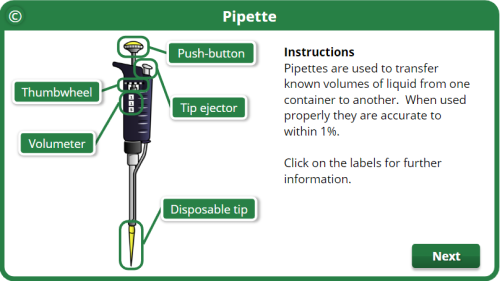
This section provides background on methods, techniques, and equipment used in the practical. Emphasis is placed on challenging areas like data handling and calculations, avoiding duplication of lecture material but applying the knowledge in a practical setting. Interactive animations and videos (such as the example below) are often included, and help students to prepare for the techniques they will use in the lab.
ii) Pre-lab quiz
The pre-lab quizzes ensure student engagement and understanding of the experimental information. Quizzes are automatically marked online with feedback, and the score contributes to the total practical mark. Question banking and randomized question order reduces plagiarism. If the quizzes are seen to be fair, students are more likely to engage with them and reflect on their learning.
iii) Post-lab assignment
Post-lab assignments involve students entering data from their lab book into eBiolabs. Algorithmic solutions are sometimes used, enabling some post-lab questions to be automatically marked.
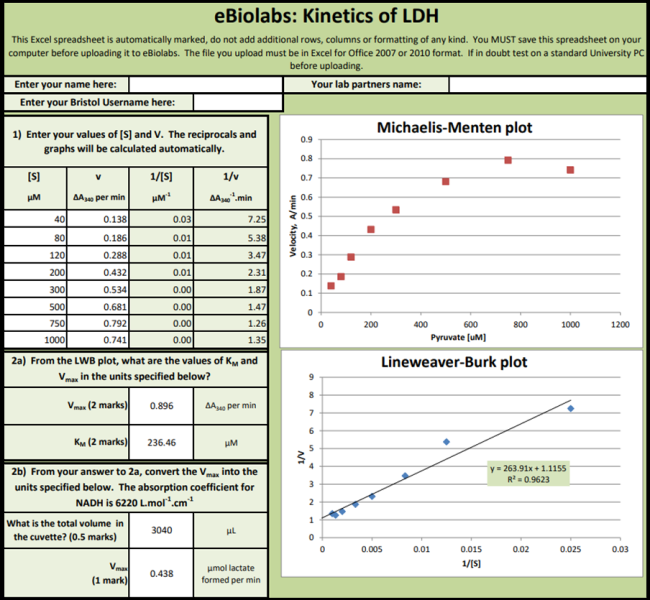
We use two types of assignment submission: one within eBiolabs for data entry and processing, and another where students upload electronic files, usually in Excel format, for more complex calculations and analysis. Other platforms such as Word, Prism or SigmaPlot can also be used, but Excel was chosen as the standard data analysis package due to its universality. We provide template files for students to complete, which can be automatically marked using Visual Basic scripts.

From the staff perspective
eBiolabs significantly reduces administrative and assessment workload. Over 25 staff days per year are saved on the first-year Biochemistry course alone. Paper assignments are eliminated, marking is streamlined, and student progress is easily monitored. Practical sessions are more enjoyable with better-prepared students who ask diverse and insightful questions. We are fully committed to using eBiolabs for all practicals and are actively creating new content.
Lessons learnt
- Focus on the core mission: laboratory sessions teach unique skills.
- Prepared learners are successful learners.
- Professional material boosts confidence in online learning.
- Essential knowledge for the lab should be in the online resources.
- Prioritise early practicals to emphasize their importance.
- Computers in the lab are not always necessary.
- Balance theory and technical knowledge carefully, favouring the latter.
- Pre-lab quizzes ensure learners are adequately prepared.
- Use question banking to discourage lack of engagement/answer sharing.
- Avoid overwhelming learners with too many pre-lab questions.
- Adjust the amount of information in the lab book based on student feedback.
- The post-lab quiz should be based on work done in the lab.
- Use eBiolabs to support students in challenging areas like maths and data handling.
- Consider varying levels of digital literacy among students.
- High-quality materials are valued by learners for reference.
- Encourage students to provide feedback and improvement suggestions.