
Publications
Christine Lee & Neville Morley (eds.), A Handbook to the Reception of Thucydides (Malden MA: Wiley-Blackwell, 2015)
1. Introduction: Reading Thucydides: Neville Morley & Christine Lee
Scholarship, Criticism and Education
2. Thucydides’ Ancient Reputation: Valerie Fromentin & Sophie Gotteland
3. The Renaissance: Scholarship, Criticism and Education: Marianne Pade
4. The Speeches of Thucydides and the Renaissance Anthologies: J. Carlos Iglesias-Zoido
5. Carving up Thucydides: the Rise and Demise of “Analysis”, and its Legacy: Jeffrey S. Rusten
6. Thucydides as an Educational Text: Oliver Schelske
7. On Translating Thucydides: Emily Greenwood
Thucydides the Historian
8. Thucydides and his “Contemporaries”: Ellen O’Gorman
9. The Thucydidean Clio between Machiavelli and Hobbes: Francisco Murari Pires
10. The Reception of Thucydides in Eighteenth- and Nineteenth-Century France: Pascal Payen
11. On Historical Time and Method: Thucydides’ Contemporary History in Nineteenth-Century Britain: Alexandra Lianeri
12. Thucydides in 19th-Century Germany: Historicization and Glorification: Klaus Meister
13. Thucydides in the Twentieth and Twenty-First Centuries: Jon Hesk
Thucydides the Political Theorist
14. Hobbes and his Contemporaries: James Jan Sullivan
15. “L’historien des politiques”: Universalism and Contextualism in the Abbé de Mably’s Reception of Thucydides: Ben Earley
16. The Straussian Thucydides: Seth N. Jaffe
17. Realism, Constructivism and Democracy in the History: John Zumbrunnen
18. Thucydides and the Problem of Citizenship: Gerald Mara
19. Thucydides and Democratic Horizons: Christine Lee
Thucydides the Strategist
20. The Reception of Thucydides in the History of International Relations: Edward Keene
21. Thucydides and the Just War Tradition: Unlikely Bedfellows?: Cian O’Driscoll
22. Thucydides the realist?: Laurie M. Johnson
23. Thucydides Our Father, Thucydides Our Shibboleth: the Peloponnesian War as a Marker of Contemporary International Relations Theory: Timothy J. Ruback
24. Thucydides in the Staff College: Andreas Stradis
Thucydidean Themes
25. Thucydides and the Plague: Helen King and Jo Brown
26. The Reception of Thucydides’ Archaeology: Tim Rood
27. Thucydidean Concepts: Lorna Hardwick
28. Thucydides, Science and Late Modern Philosophy: Thom Workman
29. Thucydides in Modern Political Rhetoric: Elizabeth Sawyer
Thucydidean Reflections
30. Why We Need To Read Thucydides – Even When “We” Are Only A Few: Hunter R. Rawlings III
31. Why Teach Thucydides Today? (And If We’re At It, How?): Clifford Orwin
32. Everywhere Monuments of Good and Evil: Thucydides in the Twenty-First Century: Gregory Crane
33. Receiving the Reception: Geoffrey Hawthorn
Conclusion
34. The Idea of Thucydides in the Western Tradition: Neville Morley
Neville Morley, Thucydides and the Idea of History (London: I.B. Tauris, 2014)
Short-listed for the Runciman Award of the Anglo-Hellenic League, 2015
Neville Morley, 'Monumental Folly': Aeon October 2012
We take Pericles' Funeral Oration out of context at our peril. For a true picture of war, read Thucydides to the end...
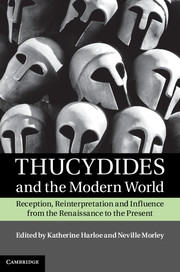
Katherine Harloe & Neville Morley (eds.), Thucydides and the Modern World: reception, reinterpretation and influence from the Renaissance to the present (Cambridge: CUP, 2012)
 Link to the CUP catalogue
The ancient Greek historian Thucydides has had an enormous impact on modern historiography, political theory, international relations and strategic studies, but this influence has never been properly studied. This book brings together leading scholars from a range of disciplines to explore the different facets of Thucydides' modern reception and influence, from the birth of political theory in Renaissance Europe to the rise of scientific history in nineteenth-century Germany and the triumph of 'realism' in twentieth-century international relations theory. Its chapters consider the different national and disciplinary traditions of reading and citing Thucydides, but also highlight common themes and questions; in particular, the variety of images of the historian produced by his modern readers: the scientific historian or the artful rhetorician, the brilliant analyst of society and politics or the great narrator of political and military events, the man of experience and affairs or the man of contemplation and reflection. This volume brings together papers from the original 2007 research workshops (funded by the AHRC) on the reception of Thucydides, held in Bristol, Oxford and Cambridge, with some specially commissioned chapters.
(1) ‘Introduction: the modern reception of Thucydides’: Katherine Harloe (Reading) & Neville Morley (Bristol)
(2) ‘Thucydides and the bellicose beginnings of early modern political theory’: Kinch Hoekstra (Berkeley)
(3) ‘Thucydides the Thermidorian; the rediscovery of democracy in the eighteenth and nineteenth centuries’: Nadia Urbinati (Columbia)
(4) ‘Historicizing the classics: how nineteenth-century German historiography changed the perspective on historical tradition’: Johannes Süssmann (Frankfurt)
(5) ‘The Education Offered by Athens: Thucydides and the stirrings of democracy in Britain’: Elizabeth Potter (Oxford)
(6) ‘Thucydides, History and Historicism in Wilhelm Roscher’: Neville Morley (Bristol)
(7) ‘The reception of Pericles’ Funeral Oration’: Jennifer Talbot Roberts (City University of New York)
(8) ‘The Greek Thucydides: Venizelos’ Thucydides and modern Greek fiction’: Emily Greenwood (St Andrews)
(9) ‘Thucydides and ‘realism’ among the classics of international relations’: Steve Forde (U. of North Texas)
(10) ‘Thucydides from the Cold War to today’: Richard Ned Lebow (Dartmouth)
(11) ‘Receiving Thucydides in modern politics’: Geoffrey Hawthorn (Cambridge)
Neville Morley, 'Peter Handke's Thucydides', Classical Receptions Journal 4.1 (2012)
Noch einmal für Thukydides, a collection of prose pieces by the Austrian writer Peter Handke, invites reflection on the history of his engagement with this classical author. In Kindergeschichte, he draws on a reading of Thucydides as a war narrative in order to solve the problems he experienced in telling the story of the relationship between a father and daughter. Handke's reading of Thucydides differs significantly from the prevailing modern traditions of reception; and, unlike those who revere the ancient author solely as an analyst and critic, he explores what it might mean to write as a modern Thucydides.