

We were delighted to sponsor the team, led by University of Bristol PhD student, Joseph Moore and Lecturer and Research Associate in High Performance Computing, Aditya Sadawarte.
Various institutions were represented, including the University of Bristol, Imperial College London, Cardiff University / Prifysgol Caerdydd, Durham University, and University of Warwick.
The team achieved a winning score in one of the benchmarks: High Performance Linpack - Mixed Precision (HPL MxP). Joseph reported that "mixed precision is important here as AI uses low precisions such as 4-bit, 8-bit or 16-bit precisions for faster performance. We achieved a score of 4799 Petaflops which is very high. This isn't possible to compare against Isambard-AI for example as they're two very different sizes of systems. That is 4799 thousand trillion calculations per second!"
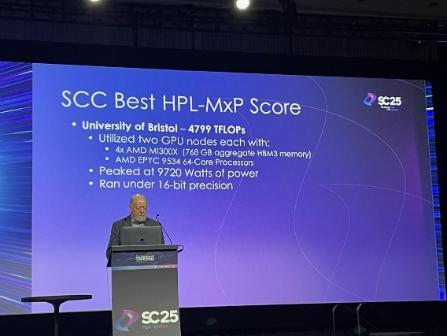
The success for the team didn't end there, as they also came 3rd in the HPL (the main HPC benchmark), and 3rd in the MLPerf, which was a benchmark for how fast they could inference Meta's Llama 3.1 70B AI model (a huge 70 billion parameters).
Overall, the team finished a close 2nd on the benchmarking portion of the competition, which is an amazing achievement.
Tom Shtasel, the team’s captain, had previously participated in a similar competition beforehand. “I had a second very similar experience (at SC25) but at a larger scale. This meant a larger cluster, tougher competition and bigger conference.”
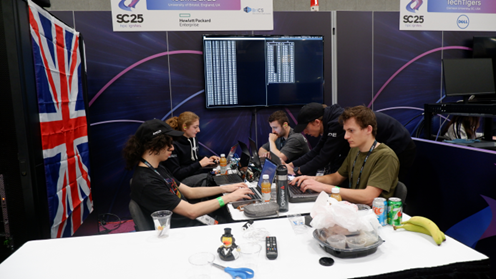
It was a challenging yet rewarding experience for the Isambards. Toby Davis, another member of the team, commented “Working hands-on with such a large cluster and all the problems that follow is a huge learning experience. We were forced to solve problems with things we'd never even heard of before stepping onto the competition floor.”
SC26 will be taking place in Chicago next year, where BriCS hope to sponsor a student cluster competition team again – watch this space!