
The Bristol Evaluation of Advertising Restrictions (BEAR) study: Findings from the baseline data
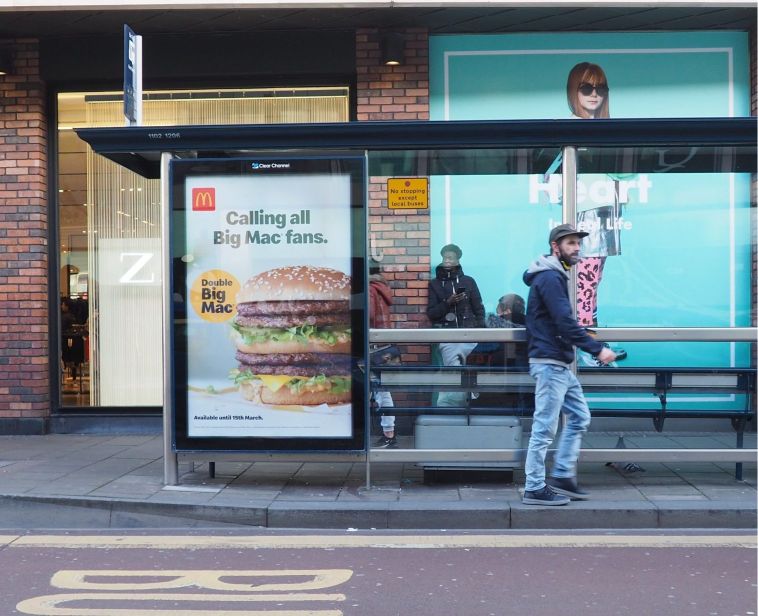
Research has shown that the more people see ads for unhealthy products, the more they use them. This might be especially true for children and young people.
Outdoor public spaces such as bus stops and billboards are important locations for ads because many people see them. People on low incomes tend to live in areas where they are exposed to more outdoor ads. Evidence suggests removing these ads can have positive impacts on the health of the public.
In 2019, Transport for London banned advertisements for high fat, salt and sugar foods and drinks on its premises. Research suggested that this policy resulted in households consuming food and drink with fewer calories.
In 2021, Bristol became the first city outside London to introduce similar measures. In addition to banning advertising of unhealthy food and drink, Bristol City Council’s policy also restricts ads for alcohol, gambling and payday loans.
Project aims
This current work is part of the larger BEAR study, evaluating the effectiveness and impact of the Bristol advertising policy. The larger project aims to compare the impact of Bristol’s new outdoor advertisement policy with other areas that haven’t got a similar policy.
We want to find out:
- Whether the policy reduced the number of unhealthy products being advertised in Bristol
- Whether people used or bought less of these products
- The impact on people’s health and associated health costs
- What people thought about the policy
- What policymakers and others, such as those selling fast-food, thought of the policy
In this initial work, we were interested in:
- Understanding the rationale, barriers and facilitators to implementing the policy
- Describing the outdoor advertising of unhealthy products that residents of Bristol and South Gloucestershire noticed, as well as their consumption of these products
We will estimate what impact the policy could have on health and health costs in Bristol.
What we did
Before the policy started in Bristol, we gathered data between January and March 2022. We did this by distributing a specially designed survey among people from Bristol and neighbouring South Gloucestershire, which doesn’t have a policy like this.
The survey asked residents whether they had seen advertisements for unhealthy products, alcohol or gambling in their local area and also whether they consumed those products. We did this to find out where people were seeing adverts and what effect this had on them.
In addition to this, three of our researchers travelled to advertising sites listed on the council’s database. They used their phones to photograph the advertisements displayed at these sites. We did this to compare the difference between what we recorded and what people reported seeing.
Further, we talked to council staff and people from voluntary sector organisations involved in developing it. We asked participants to talk about:
- How they had been involved in the policy
- The history of the policy
- The process of planning the policy
- The anticipated impacts of the policy
- Initial challenges and facilitators facing policy development
- Future plans for the policy
What we found and what this means
Fifty-eight per cent of the people in Bristol and South Gloucestershire who responded to our questionnaire reported seeing advertisements for unhealthy products in the week before they were asked to complete it. This was highest for high fat, salt and sugar foods (40 per cent).
Sixteen per cent of residents reported seeing advertisements for high fat, salt and sugar foods appealing specifically to children. For these products in particular, younger people were more likely to report seeing adverts than older people. Those living in more deprived areas were also more likely to come across this type of advertising.
We found that people’s self-reported exposure to outdoor advertisements correlated with our audit of advertising sites. This means that asking people to report on their exposure to outdoor advertisements might be a useful methodology for population studies. However, we know that self-reported exposure can be biased and measurement errors can be significant so inferences from studies using this exposure metric should be made with caution.
During interviews we were told that the climate for introducing the policy in Bristol was broadly supportive, especially as the council had recently signed up to a national healthy weight initiative. Our interviewees confirmed that it was easier to build their case for this policy because of the “groundwork” previously done by Transport for London and hoped that introducing it would bring down the volume of unhealthy products people were buying in the long term.
Barriers to the policy included:
- The council owning a relatively small proportion of the outdoor advertising space in Bristol
- The potentially limited reach of restrictions
- The conflict between some of the restrictions and the objectives of other council departments, such as promoting Bristol’s economy through festivals
Overall, our results suggest that younger people and those living in more deprived areas are more likely to see unhealthy product advertisements, particularly for unhealthy food and drinks. This means that policies specifically restricting such advertisements may have the potential to reduce health inequalities, as was hoped when this policy was developed.
Future evaluation of these types of policies should provide evidence of any public health impact.
What next?
We are currently collecting follow-up data. Following the implementation of the policy, we have again sent our survey out to residents in Bristol and South Gloucestershire.
We will analyse whether the food and drink residents of Bristol consume has changed. We will compare this with residents of South Gloucestershire where there is not a similar policy.
We plan to estimate what impact the policy could have on health and health costs in Bristol.
Papers
News and other links
Researchers call for unhealthy product advertising changes at Evidence Week - ARC West
Advertising unhealthy commodities - rationale for a new advertisement policy - ARC West
Read the BMJ investigation which cites this project: Bans on junk food advertising in outdoor spaces derailed by industry lobbying | The BMJ