
When did flowers originate?
Flowering plants likely originated between 149 and 256 million years ago according to new UCL-led research, co-authored by the University of Bristol.

Flowering plants likely originated between 149 and 256 million years ago according to new UCL-led research, co-authored by the University of Bristol.

For the first time, scientists have recreated the journeys of millimetre-sized baby coral through the world’s seas, suggesting some of these tiny adventurers may cross entire oceans. The study, by researchers from the Universities of Bristol and Miami, will help predict how coral reef distributions may change in response to changing oceans.
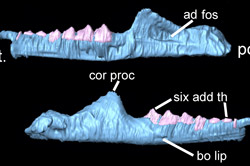
Fossils found in a quarry near Cardiff in South Wales have been identified by a student and her supervisors at the University of Bristol as a new small species of reptile that lived 205 million years ago.

World-leading research being carried out in Bristol to identify the colour of prehistoric animals is being showcased at the largest science and technology fair in Asia, attracting some 1.2 million visitors each year.

Bristol's very own dinosaur Thecodontosaurus will be brought to life on the city's Harbourside this autumn when local artist Robert Nicholls and Pedro Viegas from the University of Bristol build a full-size replica of the beast, based on the very latest scientific discoveries about how it would have looked when it roamed around Bristol 210 million years ago.

The rediscovery of a mystery animal in a museum’s underground storeroom by an undergraduate at the University of Bristol proves that a non-native ‘big cat’ prowled the British countryside at the turn of the last century.

A collection of important fossil specimens are coming back to their home town in Somerset for an outreach open day, thanks to a partnership between Bath Royal Literary and Scientific Institution (BRLSI) and the University of Bristol.

The acidity of the world’s ocean may increase by around 170 per cent by the end of the century bringing significant economic losses, according to a major new international report. People who rely on the ocean’s ecosystem services – often in developing countries – are especially vulnerable.
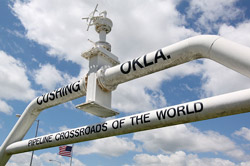
Man-made earthquakes in Oklahoma, USA, are strongly linked to the depth at which wastewater from the oil and gas industry are injected into the ground, according to a new study led by the University of Bristol.

A new web tool, created by NERC-funded researchers at the University of Bristol, could pave the way for better management of airspace during volcanic crises.