
Pioneering research sheds new light on the origins and composition of planet Mars
A new study has uncovered intriguing insights into the liquid core at the centre of Mars, furthering understanding of the planet’s formation and evolution.

A new study has uncovered intriguing insights into the liquid core at the centre of Mars, furthering understanding of the planet’s formation and evolution.

A University of Bristol graduate who founded a start-up because he was sick of his job says it is now turning over half a million pounds a year.

A new set of 100-year climate projections has been created to assess the likelihood of heavy rain downpours in the UK, which can cause flash flooding, over the coming years and decades.
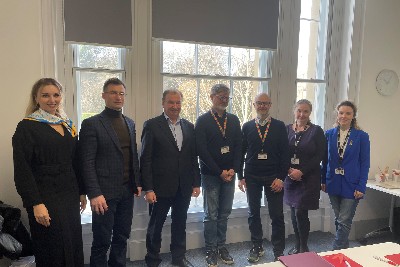
Today marks the one year anniversary of the UK-Ukraine Twinning Initiative which united the University of Bristol and the National Aerospace University: Kharkiv Aviation Institute in Ukraine as well as hundreds of other universities as part of a UK government-backed program to support higher education institutions impacted by the Russian invasion.
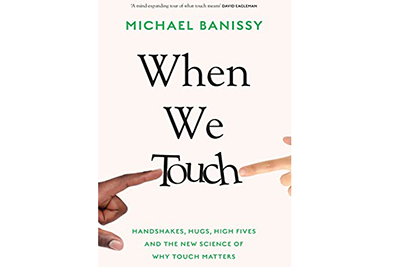
Why is a hugged person a healthier person? How does a shared handshake make you more likely to tell the truth? University of Bristol social neuroscientist, Professor Michael Banissy, one of the foremost experts on touch, explores the fascinating new science of one of our most overlooked senses in 'When we touch', published this week [30 March].
The University of Bristol is part of a £42.7 million 'Mental Health Mission' announced by the Government to accelerate research into mental health conditions, including those impacting children. The research will develop radical new treatments, improve the speed and accuracy of diagnosis and increase the use of technology to free up clinician time.

A new study has highlighted how cryptocurrency investors often suffer gambling-related harms – and online gambling outlets accepting cryptocurrency as wagers pose even greater risks.

Do you want to take part in vital research into separation anxiety in dogs? If so, the University of Bristol Veterinary School and the School of Physiology, Pharmacology and Neuroscience wants to hear from you.

Countries must intensify efforts to track HIV and hepatitis C virus (HCV) incidence among people who inject drugs, and to prioritise this group in prevention and elimination work, according to new University of Bristol-led research, published online in The Lancet Gastroenterology & Hepatology.
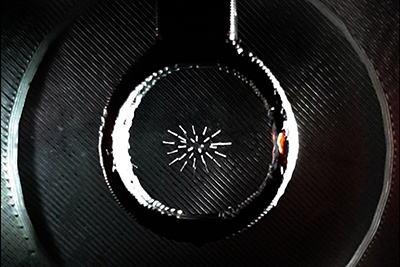
Critical insights into why airborne viruses lose their infectivity have been uncovered by scientists at the University of Bristol. The findings, published in the Journal of the Royal Society Interface today [21 June], reveal how cleaner air kills the virus significantly quicker and why opening a window may be more important than originally thought. The research could shape future mitigation strategies for new viruses.