
Hydrothermal and volcanic systems
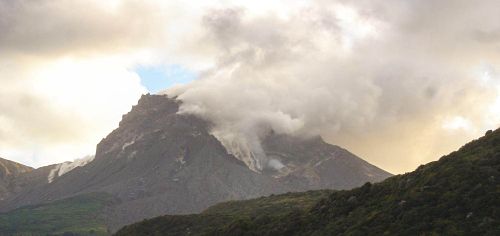
Soufriere Hills Volcano, Montserrat Island (view from Trant's, Feb 2013). Photo credit: Alia Jasim
Volcanoes are complex and dynamic systems that are closely related with human life. Volcanic risk mitigation is only one of the aspects that drives our efforts on understanding these active systems; the massive heat flux in active volcanic terrains make them interesting for geothermal exploration, meaning potential energy self-sufficiency for many areas of the planet. Furthermore the strong interplay between magmatic components, host rock and fluid flow may play a key role in the formation of ore deposits. These are only some of the aspects that are focusing our interest in the upper few kilometres of the crust, from the topographic surface to the magma chamber.
We are currently investigating the hydrology of active volcanic islands, the role of fluids in changing physical and chemical properties of volcanic rocks and the magma-aquifer interaction. All our projects involve fieldwork, lab work and modelling. Our work ties in with other projects being undertaken at Bristol:
- VUELCO (Volcanic Unrest in Europe and Latin America)
- Bristol PCD (Porphyry Copper Deposits)
- Ethiopia geothermal project
Volcanic risk
The range of phenomena that we are able to investigate are related to the development of overpressure within the hydrothermal system that, when degassing is inhibited, likely leads to ground deformation, seismic activity and eventually phreatic eruption. With our numerical codes we describe the complex interaction between fluid flow and geochemical reactions to predict the spatial and temporal distributions of fluid and rock properties associated with a wide range of reactions.
Volcanic risk mitigation (Risk = Hazard * Vulnerability) is usually carry on through the reduction of vulnerability, that means reducing the potential losses due to volcanic activity. In densely populated area reducing the vulnerability means answering three basic, yet not simple, questions: when is the next event? Where is the next event? What does the next event look like? Feeding advanced numerical codes with real time data, we are able to forecast the evolution of the shallow system giving answers on both the “when” and the “where” questions. Also the possible scenarios produced through numerical simulation are a tool to verify our interpretation of field data that is crucial during unrest crisis.
Furthermore we focus our attention on the recharge dynamics of hydrothermal reservoir and alteration rate of the host rock. Those two processes are crucial in the development of low permeability rocks around volcanoes inhibiting degassing and enhancing slope failure in high relief volcanoes. Both processes can potentially trigger more catastrophic event. These volcanic hazards are somehow hidden because they are mainly related to water rock interactions, they don’t show major warning signals and most importantly they keep altering the strength of the edifice even during period of no or low activity. Locate in time and space altered rocks means reducing the risk associated with flank collapse via urban plans and evacuation strategies.
Geothermal energy
The presence of permeable rocks, heat source and hydrological recharge system make each magmatic hydrothermal system a potential resource of energy. Many countries in the world are starting to exploit this resource and some of them, among the others New Zealand and Iceland, have already reached energy self-sufficiency thanks to geothermal power plants.
We haven’t fully explored the potential of our suite of simulators for non-isothermal multiphase flow and transport in fractured porous media (TOUGH) but the applications for geothermal explorations are clear and appealing.
Ore deposits
The interplay between mineral resources and technological progress goes at the same speed than human development. Ore deposits form in many different ways but hydrothermal fluids are the most efficient heat and mass transfer in the crust.
In magmatic hydrothermal system fluids are even enriched in magmatic components (metals, sulphur, rare earth), enhancing chemical exchange with the host rock. The deep portion of magmatic hydrothermal system reaches supercritical conditions, and boiling through decompression is one of the main figures of magmatic hydrothermal system. Fluids rock interactions and boiling are the main processes that lead to the formation of ore minerals. The location and distribution of the resource, that determine if the deposit is sufficiently rich to be worked at a profit, is related to the complex interaction between fluid flow and structural controls. Feeding our numerical models with realistic geological data we are able to illustrate the evolution of ore deposit in time and space.
Working in this area
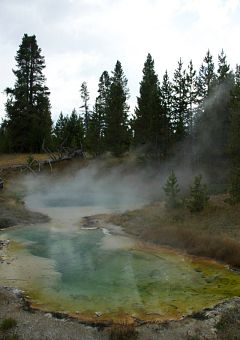
Yellowstone, boiling pool. Photo credit: Miles Frazer