
Carbonate Diagenesis
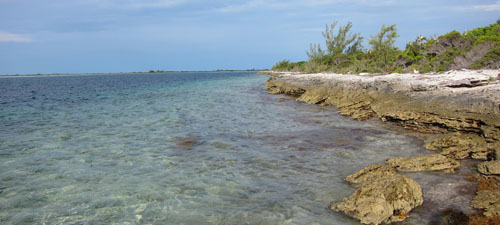
Joulters Cay, Bahamas. Photo Credit: Miles Frazer
We study the processes that alter carbonate rocks post deposition, collectively termed as diagenesis.
We use a combined approach of field case studies and reactive transport modelling to understand the processes driving the diagenesis in different hydrological settings. As diagenesis can occur at any point in a rocks history it is important that we aim to study different types of fluids which can interact with the rocks.
Meteoric Diagenesis
Meteoric, freshwater, diagenesis is often the first stage of alteration and tends to occur early on in diagenetic history. Over the past 20 years, the group has been involved in characterising this process through understanding the hydrogeology and biogeochemistry of a modern exposed islands in the Bahamas.
This work, along with field explorations in other modern carbonate environments (Yucatan and Guam), has been used to generate reactive transport models to understand the distribution and rates of diagenesis. Also the field characterisations have been used in the development of CARDB3D+, an forward sedimentological and diagenetic modelling tool. Most recently this has been used to understand the development of meteoric diagenesis of the Tengiz platform, a large oil and gas reservoir in Kazakhstan.
Dolomitisation
Dolomitisation is the process by which precursor limestone is altered to dolomite, through the replacement of calcium ions in the crystalline structure with magnesium ions. Although dolomite is a common rock in the rock record, the processes by which it is formed, along with the hydrological settings, still cause controversy
We use reactive transport models to test hypothesis of dolomite formation in a number of different hydrological settings and also try to understand the key controls to the process. Further information on one of the major dolomitisation projects can be found on the ITF Dolomite page.
Burial Diagenesis
Once carbonate successions are buried, high temperature and pressure fluids can further interact with the rock causing extensive diagenesis. This is of particular importance when trying to understand oil and gas reservoirs burial history and how this could have altered the porosity and permeability networks.
The burial history of a Carboniferous platform has been recreated using basin scale fluid models.
Working in this area
Image caption goes here