
Carb3D+
Carb3D+ is an innovative forward model for prediction of the sedimentology, sedimentary architecture and diagenesis of carbonate platforms.
It is a process-based model which includes: wave and current hydrodynamics, transport of bed and suspended sediments, differential subsidence in space and time, angle of repose slopes and both syn-depositional and final burial compaction. The model simulates early diagenetic changes in carbonate mineralogy and porosity, including tracking of cements and secondary porosity.
Model overview
Carb3D+ utilises the association between the key extrinsic variables that control sedimentary architecture and sedimentology of carbonate platforms (eustatic sea level and subsidence which together determine accommodation) and the hydrological zones within the platform. Other extrinsic variables are ocean and wave climate determining the sedimentary processes occurring and their rates and distribution in space, and terrestrial climate controlling recharge and the rates of diagenetic processes. Carb3D+ includes depth and grain size dependence of diagenetic rates, and feedback between adjacent hydrozones.
Developing and improving new algorithms for Carb3D+ is a continuous task, largely supported by funding from our industrial sponsors. We combine published literature with our own hydrochemical fieldwork in modern carbonate areas such as the Bahamas, Yucatan and Guam and Reaction Transport Modelling (RTM). The RTM provide information on rates distribution and dependencies which can be included into Carb3D+ using simplified rules.
Output
Carb3D+ has the flexibility to output a variety of model parameters and has a number of diagnostics built-in. The types of outputs include: Dunham facies, rock properties (such as porosity and permeability), and diagenetic products. All these can either be displayed as user-defined cross sections, areal maps or 3D sections.
Funding
Our work on CARB3D+ is supported by the Bristol Carbonates Consortium. This is an informal grouping of major oil companies (which has included: BHP Billiton, Chevron, ConocoPhillips, ENI, ExxonMobil and Petrobras) and the Natural Environment Research Council (NERC) who provide finance, and advise on future research directions.
Sponsors Area
Downloads and various consortium documentation is available to sponsors
Educational Users
Carb3D+ has been used at the University of Bristol and VU University as a teaching tool.
Working in this area
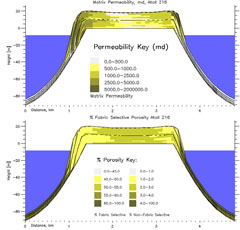
2D cross sectional outputs of porosity and permeability from Carb3D+. Photo Credit: Katherine Cooper