MISSIONARIES IN CHINA
A General Background to the Missionaries in China
 In
the eighteenth century China claimed to be the greatest empire on Earth. The Qing dynasty was vast. However, by the mid nineteenth century
administration of the Chinese empire was reaching stagnation but they remained
confident that they were still the ‘Celestial Empire’ and viewed with distain
the attempts of Western society to force an entry. It was from the 1840’s that this pride and self-confidence was
hit hard when the Great Powers began to carve up their country, like it was
some giant cake that they all wanted a piece of. The missionaries became a symbol of foreign intrusion and were
hated by many Chinese citizens, rich and poor alike. In this web site, however, we would like to illustrate that
perhaps the missionaries were not all imperialistic, uncaring Westerners but
families who genuinely wanted to further the word of God but were met with much
resistance.
At the beginning of the missions to China it was only possible to obtain residential rights in Canton and Macao. These two cities were only a tiny proportion of China but soon more of China opened up to the Westerners. A Prussian missionary, Karl Gutzlaff discovered northern outlets for opium traffic in the 1830’s. He published accounts of his voyages along the Chinese coast and placed China on the map of the British missionary for the first time. Although Christians opposed the opium trade there was excitement when the treaty guaranteed rights for foreigners in different ports, opening doors in new cities (Amoy, Foochow, Ningpo and Shanghai). However, it was difficult in the formative years to find candidates for China as Christian interest in the country
 tailed
off during the 1840s. After the Taiping
Rebellion in 1853 there was a rise in interest again and missionaries flocked
to China. When the Westerners arrived
some adopted Chinese dress to try and integrate into society. James Hudson
Taylor horrified the foreign community in Shanghai when he shaved his head and
adopted Chinese dress. Many of the missionaries
stayed for years hardly returning to England but adopting China as their home.
The missionaries came up against much resistance from the native citizens as they felt that the missionaries were ‘guilty of foisting their own cultural values on their converts.’ This resistance grew until violence broke out in the Boxer Uprising. Both Catholic and Protestant churches in the North suffered at the hands of the Boxers. The Catholics lost nearly 50 missionaries and 30,000 native Christians and the Protestants 135 adult missionaries and 53 children.
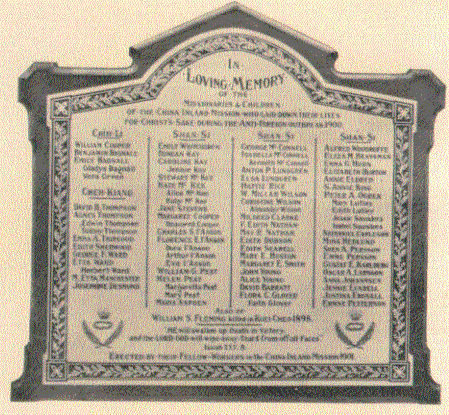
Others suffered attacks on their property and were continually bombarded with anti-foreign propaganda. Some however, were successful in their quest to establish a stable station and converted many ‘heathens’ to the Christian faith. A few examples of such cases will be described in detail in the individual reports contained in this website.
Who are we?
We are five undergraduate students from Bristol University, UK studying China and the Boxer Uprising in the first year. These series of reports have been done individually to try and give different slants on the common theme of missionaries in China, during the nineteenth century. Five of the main provinces have been chosen – Shandong, Shansi, Zhilli, Peking and Mongolia. We have attempted to find personal accounts of missionaries who experienced China in the nineteenth century rather than relying solely on secondary historical reports.